
Your Health Plan Is Financing an AI Arms Race — And Employers Are Paying the Bill
For the last few years, employers have heard almost nonstop about the promise of artificial intelligence.

VP of Employee Benefits · BHC Insurance · Independent Benefits Consultant
For the last few years, employers have heard almost nonstop about the promise of artificial intelligence. AI is supposed to make healthcare more efficient, reduce administrative work, help physicians spend more time with patients, improve navigation, automate claims review, and finally make sense of the enormous amount of data moving through the healthcare system.
I believe a lot of that will happen. But there is another side of AI in healthcare that employers need to start paying much closer attention to, because while employers are asking how AI might someday help them control healthcare costs, providers and insurance companies are already using increasingly sophisticated technology on opposite sides of the healthcare transaction.
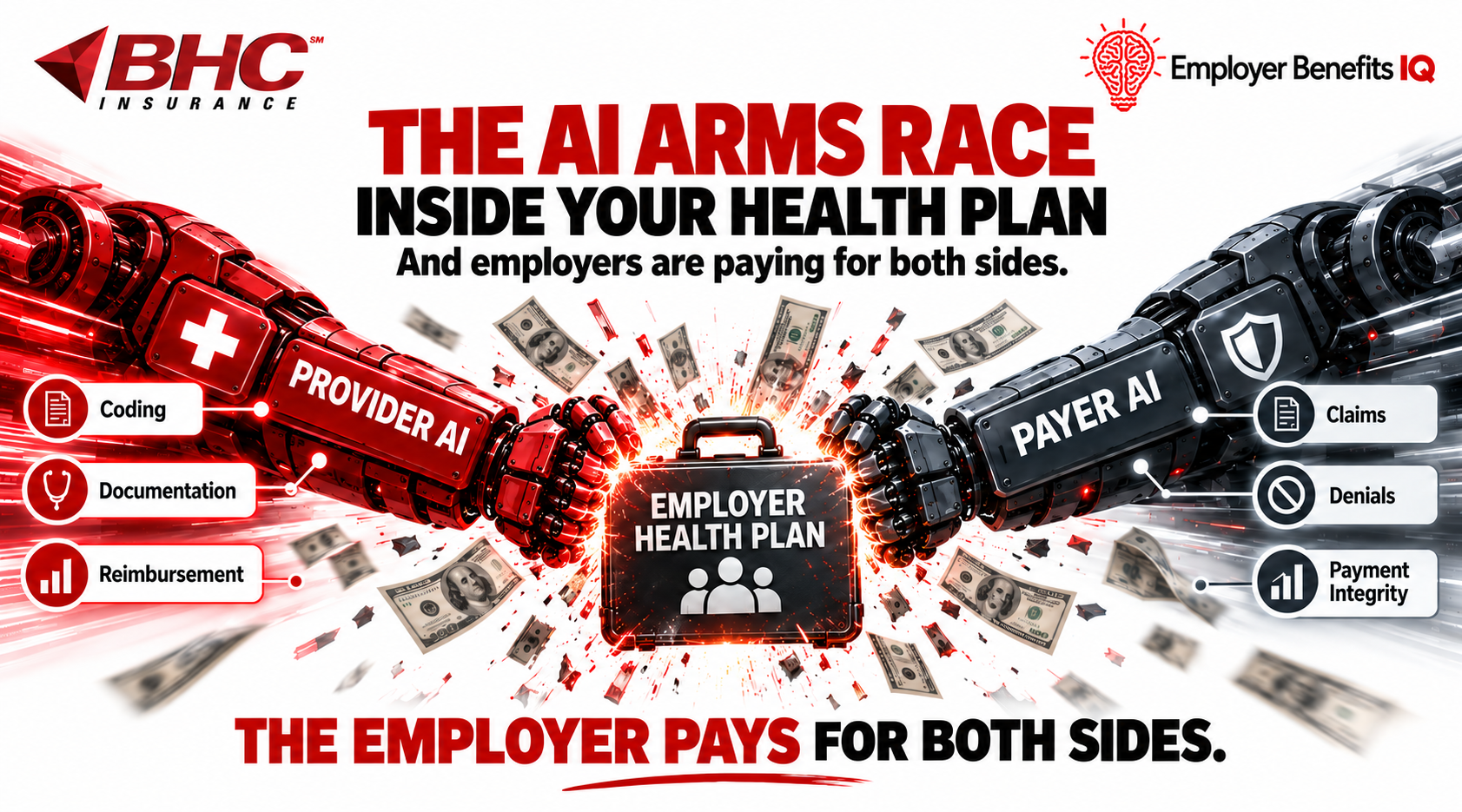
Providers are using AI-enabled tools to improve clinical documentation, identify billable diagnoses and services, support coding decisions and capture reimbursement. Health plans are using technology to review those claims, identify potential overpayments, apply payment-integrity rules and, in some cases, reduce or deny payments. Both sides have a strong financial incentive to become better at what they do, and sitting in the middle of that increasingly sophisticated contest is the employer health plan.
That is the part I don't think we are talking about enough.
The technology is moving faster than most employers realize This is not some theoretical issue that might matter five years from now. Marsh recently projected that employer health benefit costs will increase an average of 8.2% in 2027, the largest increase since 2003. Employers reported that their current plans would increase approximately 11% without cost-reduction measures, and among the factors Marsh identified was the rapid adoption of AI-enabled software that assists physicians with claims submission and can result in more claims, as well as higher-level claims, being submitted for payment. Marsh's actuaries estimate this development alone could add as much as a percentage point to medical trend. (mercer.com)
We spend enormous amounts of time talking about GLP-1 medications, specialty pharmacy, cancer treatments, and catastrophic claims, and we should because those are significant cost drivers. But we may also be entering an era where the sophistication of the billing process itself becomes a meaningful healthcare cost driver.
The U.S. Government Accountability Office recently examined the use of AI for medical documentation and coding. There are legitimate benefits. Physicians spend enormous amounts of time on documentation and administrative tasks, and better technology can reduce that burden. At the same time, the GAO noted that the accuracy of these systems can be difficult to verify and that their overall impact on healthcare spending remains uncertain. (gao.gov)
That uncertainty should matter to employers because healthcare does not operate like most other markets. In most businesses, becoming more efficient should eventually make the product or service cheaper. In healthcare, becoming more efficient at identifying everything that can be documented and billed may have the opposite effect.
Better documentation or better revenue capture? This is where the conversation gets uncomfortable.
If a physician treats a legitimately complex patient and AI helps accurately document that complexity, the provider should be paid appropriately. Employers should not expect doctors and hospitals to undercode services simply because inaccurate coding happens to save the health plan money. Better documentation is not automatically upcoding.
The American Hospital Association has pushed back strongly against suggestions that increasing coding intensity is simply the result of providers using AI to inflate reimbursement. Hospitals argue that patients are becoming more complex, chronic disease is increasing, less complex care is moving outside the hospital, and coding rules themselves continue to change. They also argue that AI can improve coding accuracy and reduce administrative burden. (aha.org)
Those are fair points. But insurers are looking at the same environment and raising different questions.
The Blue Cross Blue Shield Association released research this year suggesting that AI-enabled coding may be contributing to more aggressive coding patterns. In one analysis involving maternity admissions, researchers found increases in diagnoses that were not always accompanied by the types of treatment they would have expected to see. BCBSA estimated approximately $2.3 billion in inpatient and outpatient spending could be associated with more aggressive AI-enabled coding practices. (bcbs.com)
Providers dispute that interpretation, but the disagreement itself is what employers should be watching. Once providers develop increasingly sophisticated technology to support documentation and reimbursement, payers have an obvious incentive to develop increasingly sophisticated technology to scrutinize it. The provider has an algorithm, the insurer has an algorithm, the payment-integrity company may have another algorithm, and the utilization-management platform may have another.
Meanwhile, the employer funding the plan often receives a spreadsheet several months later telling them that medical claims increased 12%.
That is not healthcare management.
Employers are financing both sides of the fight This is what bothers me most about the direction of the market. Employers can end up paying for almost every layer of the administrative battle. They pay the healthcare claim, the carrier or TPA fee, the payment-integrity vendor, and the administrative expense created when claims are challenged, reviewed, appealed, or repriced. They also ultimately feel the financial effect of higher negotiated reimbursement and increasing provider costs.
When providers and payers fight over what should have been paid, those costs do not disappear from the healthcare system. They get absorbed somewhere, and eventually the employer, employee, or taxpayer finances much of it.
The industry's answer to rising complexity too often seems to be adding another layer of complexity. Providers build smarter billing systems. Payers build smarter claims systems. Employers then buy another point solution to analyze what the first two systems are doing. Everyone can point to administrative innovation while healthcare continues consuming a larger share of the employer's operating budget.
At some point, leadership teams need to ask whether technology is actually reducing the cost of healthcare or simply making everyone better at competing over the same healthcare dollar.
Those are two very different things.
The renewal will not show you this This is also why I continue to believe employers have to stop managing healthcare primarily through the insurance renewal. The renewal tells you the financial outcome, but it does not necessarily tell you what produced it.
A 10% increase might show up as a medical trend, but what actually happened underneath that number? Did utilization increase? Were hospital prices higher? Did site of care change? Did coding intensity increase? Were more services classified at higher levels? Did your plan experience more denials, appeals, or payment adjustments? Are you paying vendors to recover dollars after claims have already been paid? Are those vendors compensated based on what they recover, and how much of the savings they report represents real avoided healthcare expense rather than a disagreement over the reimbursement amount?
Most employers cannot answer those questions, and that is not because HR is failing to do its job. The healthcare purchasing system was never designed to make those answers easy to obtain. But employers are writing checks large enough that they should insist on knowing.
A company would never tolerate this level of opacity around most other major expenses. If manufacturing costs suddenly increased 10%, leadership would not simply ask the vendor what next year's increase would be. Finance would take apart the cost structure. Procurement would examine pricing. Operations would look for inefficiencies. Leadership would want to understand exactly what changed.
Healthcare deserves the same discipline.
AI is not the problem. Lack of oversight is. I do not believe the answer is to stop using artificial intelligence in healthcare. That would make very little sense.
There are clinicians drowning in documentation requirements. Fraud, waste, and billing errors run throughout the healthcare system. Some claims deserve additional scrutiny. Enormous opportunities exist to use technology to identify better care, prevent disease, improve navigation, and reduce administrative expense.
AI will be part of the solution, but employers should not assume that every efficiency created by AI automatically accrues to the employer. That is where benefits leaders, finance teams, and advisors need to become much more sophisticated.
I would start asking carriers, TPAs, and consultants different questions. Are you measuring changes in coding intensity within our claims? Can you show us changes in the distribution of higher-level evaluation and management codes? What automated payment-integrity programs are being applied to our claims? Who financially benefits when a claim is reduced or recovered? What percentage of challenged claims are ultimately overturned? Do our contracts give us access to the claims information needed to evaluate these patterns? Most importantly, what are we doing with AI to improve quality and reduce the actual cost of care rather than simply adjudicate the bill more efficiently?
Those questions are not nearly as comfortable as discussing deductibles and employee contributions, but they are much closer to the real economics of the health plan.
Employers need to become better healthcare purchasers I believe we are reaching a point where the traditional benefits-management model is no longer enough. Healthcare purchasing is becoming more sophisticated, and nearly every other participant in the transaction already understands that.
Providers are sophisticated. Insurance companies are sophisticated. PBMs are sophisticated. Healthcare technology companies are sophisticated. Private-equity-backed healthcare organizations are sophisticated. The employer cannot continue to be the least sophisticated participant in a transaction it is largely financing.
That does not mean HR leaders suddenly need to become medical coders or claims auditors. It means employers need advisors, data, contracts, and governance structures that can tell them what is actually happening to their healthcare dollar.
A high-performing health plan is not created by winning the renewal negotiation by two percentage points. It is created when an employer begins understanding and managing healthcare as an operating expense and starts asking the same questions it would ask about any other major business cost.
What are we buying? What are we paying? Who is getting paid? Why did the cost change? Did the employee receive good care? Could we have achieved the same outcome for less? Is every vendor in the ecosystem aligned with the employer and the employee?
AI does not change those questions. It makes them more important.
We may be entering a healthcare system where machines on both sides of the transaction can analyze thousands of data points in seconds, identify opportunities humans would have missed and optimize the financial outcome for the organization deploying them.
Employers should be asking who is deploying that same level of intelligence on their behalf.
If the answer is no one, we should not be surprised when the bill keeps going up.
Questions about this topic? I'm available for consulting engagements across Northwest Arkansas and beyond.
About the Author
Corry Hull, REBC®, CSFS®
VP of Employee Benefits · BHC Insurance
Corry Hull, REBC® CSFS®, is VP of Employee Benefits at BHC Insurance and the founder of Employer Benefits IQ (www.employerbenefitsiq.com). He is a Health Rosetta Advanced Advisor and a multi-year presenter at United Benefit Advisors (UBA) national conferences. He specializes in self-funded health plan design, PBM contract strategy, stop-loss structuring, group medical captives, and ACA/ERISA compliance for mid-market employers. His work has been recognized by Health Rosetta (Rosie Award, 2026), UBA (Producer Peak Performer, 2025–2024), and BHC Insurance (Producer of the Year, 2021–2025). His employer-education content has been referenced in BenefitsPro and cited within the Health Rosetta advisor community. All consulting and brokerage compensation is fully disclosed.