
Why a Well-Designed Employee Handbook Matters More Than Ever
Many organizations treat the employee handbook as a compliance document, created once, distributed during onboarding, and seldom reviewed.

VP of Employee Benefits · BHC Insurance · Independent Benefits Consultant
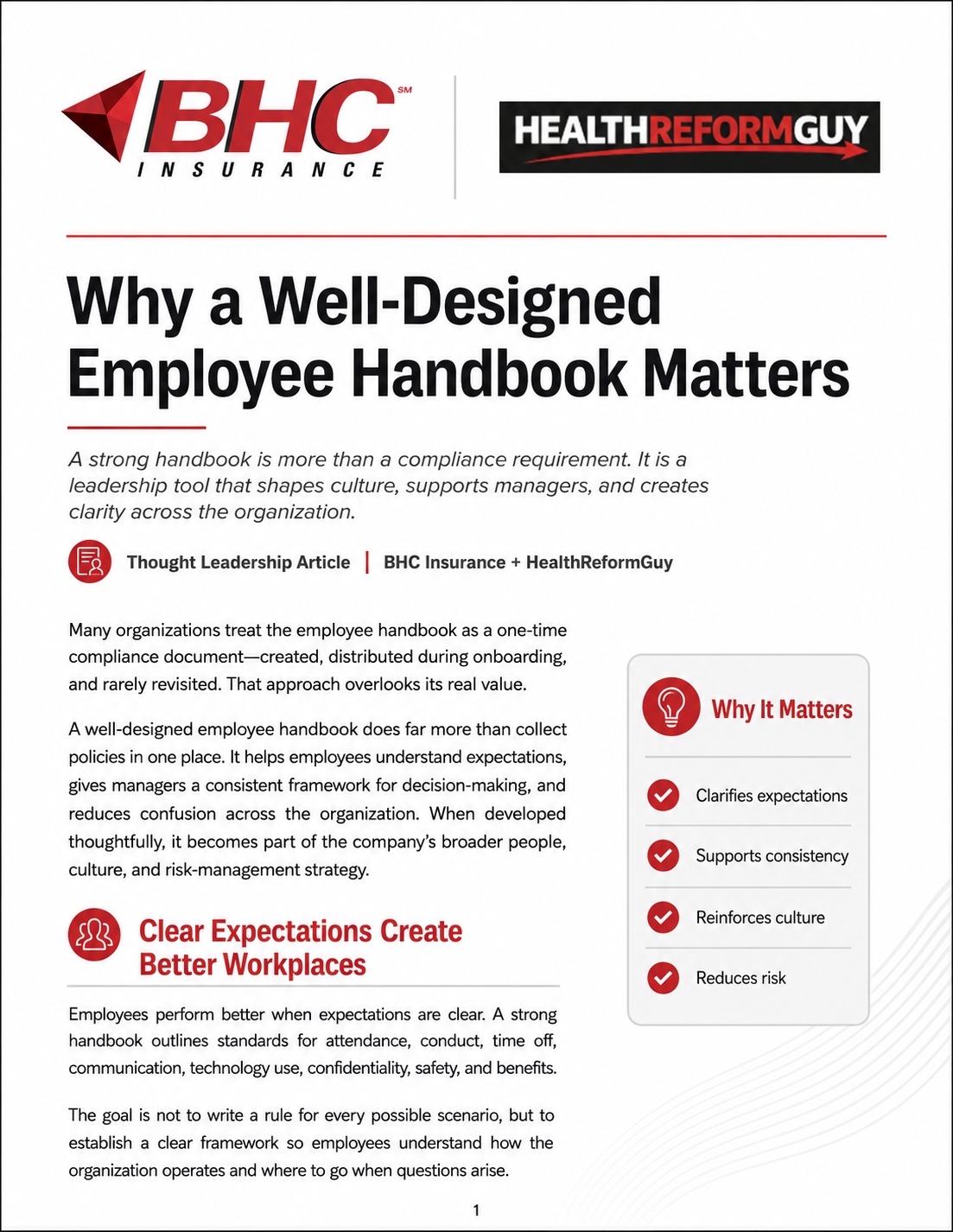
Many organizations treat the employee handbook as a compliance document, created once, distributed during onboarding, and seldom reviewed.
This approach overlooks the true value of a well-designed handbook.
An effective employee handbook is more than a collection of policies. It serves as a practical management tool, clarifying expectations for employees, providing supervisors with a consistent decision-making framework, and protecting the organization from confusion and inconsistency.
A thoughtfully designed handbook supports the organization’s overall people strategy.
Clear Expectations Create Better Workplaces
Employees perform better when expectations are clear.
A well-written handbook outlines standards for attendance, conduct, time off, communication, technology use, confidentiality, safety, benefits, and other areas that shape the daily employee experience.
Without clear guidance, employees may rely on informal conversations, assumptions, or varying interpretations from managers, leading to frustration and distrust.
The goal is not to address every possible situation, but to establish a clear framework so employees understand how the organization operates and where to seek answers.
Consistency Is One of the Best Forms of Risk Management
Many workplace problems arise not from poor policies, but from inconsistent application.
One manager may approve exceptions while another strictly follows policy. One employee may receive flexibility that another in a similar situation does not. Over time, such inconsistencies can create employee relations issues and expose the organization to risk.
A well-designed handbook provides managers with a common foundation.
It helps leadership respond consistently to similar situations while preserving appropriate discretion. This becomes increasingly important as the organization grows and more managers participate in hiring, performance management, leave administration, discipline, and termination decisions.
Consistency builds trust and makes decisions easier to explain and defend.
The Handbook Should Reflect the Actual Organization
A common mistake is using a generic handbook that does not reflect the organization’s actual operations.
A policy may appear effective on paper but can cause problems if managers do not understand it, employees cannot follow it, or there is no process for administration.
For example, a handbook may outline a detailed progressive discipline process that leadership does not consistently follow, promise flexibility supervisors cannot provide, or include outdated benefit information or leave procedures that no longer match current practices.
The best handbook is not the longest or most complex, but the one that accurately reflects the employer’s workforce, culture, management philosophy, operational realities, and legal obligations.
Policies Communicate Culture
Every employee handbook communicates something about the organization, whether intended or not.
The language, tone, structure, and policies convey how employees are viewed and how the organization expects people to work together.
A handbook written in overly legalistic or punitive language may cover important topics but can make the employer appear rigid or distrustful. Conversely, a handbook that is too informal or vague may not provide the necessary guidance for managers and employees.
The strongest handbooks achieve balance. They are professional and clear without being cold or overly complicated, and they communicate accountability while reinforcing respect, fairness, flexibility, and organizational values.
Managers Must Understand the Handbook Too
A handbook is ineffective if managers are unfamiliar with its contents.
Supervisors are often the first point of contact for employee questions about attendance, leave, workplace concerns, performance expectations, accommodations, or disciplinary issues. If managers provide answers that conflict with written policies, the handbook quickly loses credibility.
Therefore, handbook implementation should include manager education.
Leaders should know which decisions they can make independently, which require HR involvement, and when exceptions must be documented and reviewed. Managers do not need to be employment-law experts, but they must understand and responsibly apply organizational policies.
The handbook should support, not surprise, managers.
A Handbook Should Evolve With the Organization
Workplaces change. Laws change. Workplaces, laws, benefits, technology, and employee expectations all change. Three or five years ago may no longer address the organization’s current risks or workforce needs.
Remote work, flexible scheduling, social media, artificial intelligence, workplace privacy, paid leave, employee classifications, substance use, and electronic communication are just a few areas requiring ongoing attention.
Employers should review handbooks regularly and whenever there are significant changes in operations, workforce structure, benefits, management practices, or applicable law.
An annual review is a good starting point, but updates should occur as needed to keep the handbook aligned with actual organizational practices.
Acknowledgment and Communication Matter
Publishing a handbook is only the first step.
Employees should receive the handbook, know how to access it, and acknowledge receipt and review. Significant updates should be clearly communicated, not quietly added to a document employees may not revisit.
Employers should also be careful not to present the handbook as an employment contract or a guarantee that every situation will be handled in exactly the same way. Appropriate disclaimers, flexibility, and legal review are important parts of the design process.
The objective is clarity without making promises the organization cannot or does not intend to keep.
The Bottom Line
A well-designed employee handbook is not just an HR document; it is a leadership tool. It supports consistent decision-making for its managers and its employees. It supports consistent decision-making, reinforces company culture, strengthens accountability, and helps prevent small misunderstandings from becoming larger workplace problems. The most effective employers see the handbook not as a requirement, but as an opportunity to define how the organization operates and how people are treated.
This approach transforms the handbook from a collection of policies into a meaningful part of the organization’s employee benefits, compliance, and workforce strategy.
Questions about this topic? I'm available for consulting engagements across Northwest Arkansas and beyond.
Sources & Further Reading
- SHRM: Employee Handbook Development Guide — SHRM guidance on handbook content requirements, policy consistency, and legal risk management.
- DOL: Federal Employment Law Posting Requirements — Federal posting and policy disclosure requirements that handbooks must address — FLSA, FMLA, ADA, and Title VII.
- NLRB: Employee Handbook Policies and Section 7 Rights — NLRB guidance on handbook policies that may unlawfully restrict employees' rights to discuss wages, working conditions, and union activity.
- EEOC: Employer Handbook Policies and Anti-Discrimination Requirements — EEOC guidance on handbook policies covering harassment, discrimination, and accommodation procedures.
- SHRM: 2024 State of the Workplace Report — Data on the relationship between clear workplace policies, employee engagement, and retention outcomes.
The tools below are built for exactly what this article covers. Free to use — no login required.
Compliance Checklist Tool
Generate a personalized ACA, ERISA, HIPAA, and COBRA compliance checklist for your plan.
State Compliance Tool
Get a state-specific compliance checklist with exportable PDF for your plan's operating states.
Benefits Plan Checkup
Free 5-step scored assessment of your plan across cost, compliance, pharmacy, vendor management, and employee experience.
About the Author
Corry Hull, REBC®, CSFS®
VP of Employee Benefits · BHC Insurance
Corry Hull, REBC® CSFS®, is VP of Employee Benefits at BHC Insurance and the founder of Employer Benefits IQ (www.employerbenefitsiq.com). He is a Certified Health Rosetta Advisor — one of fewer than 200 nationwide — and a multi-year presenter at United Benefit Advisors (UBA) national conferences. He specializes in self-funded health plan design, PBM contract strategy, stop-loss structuring, group medical captives, and ACA/ERISA compliance for mid-market employers. His work has been recognized by Health Rosetta (Rosie Award, 2026), UBA (Producer Peak Performer, 2025–2024), and BHC Insurance (Producer of the Year, 2021–2025). His employer-education content has been referenced in BenefitsPro and cited within the Health Rosetta advisor community. All consulting and brokerage compensation is fully disclosed.