
The Other Battle for Shelf Space: The Talent and Benefits Challenge Facing Northwest Arkansas Retail Suppliers
If you work in the Northwest Arkansas retail supplier community, you already understand competition.

VP of Employee Benefits · BHC Insurance · Independent Benefits Consultant
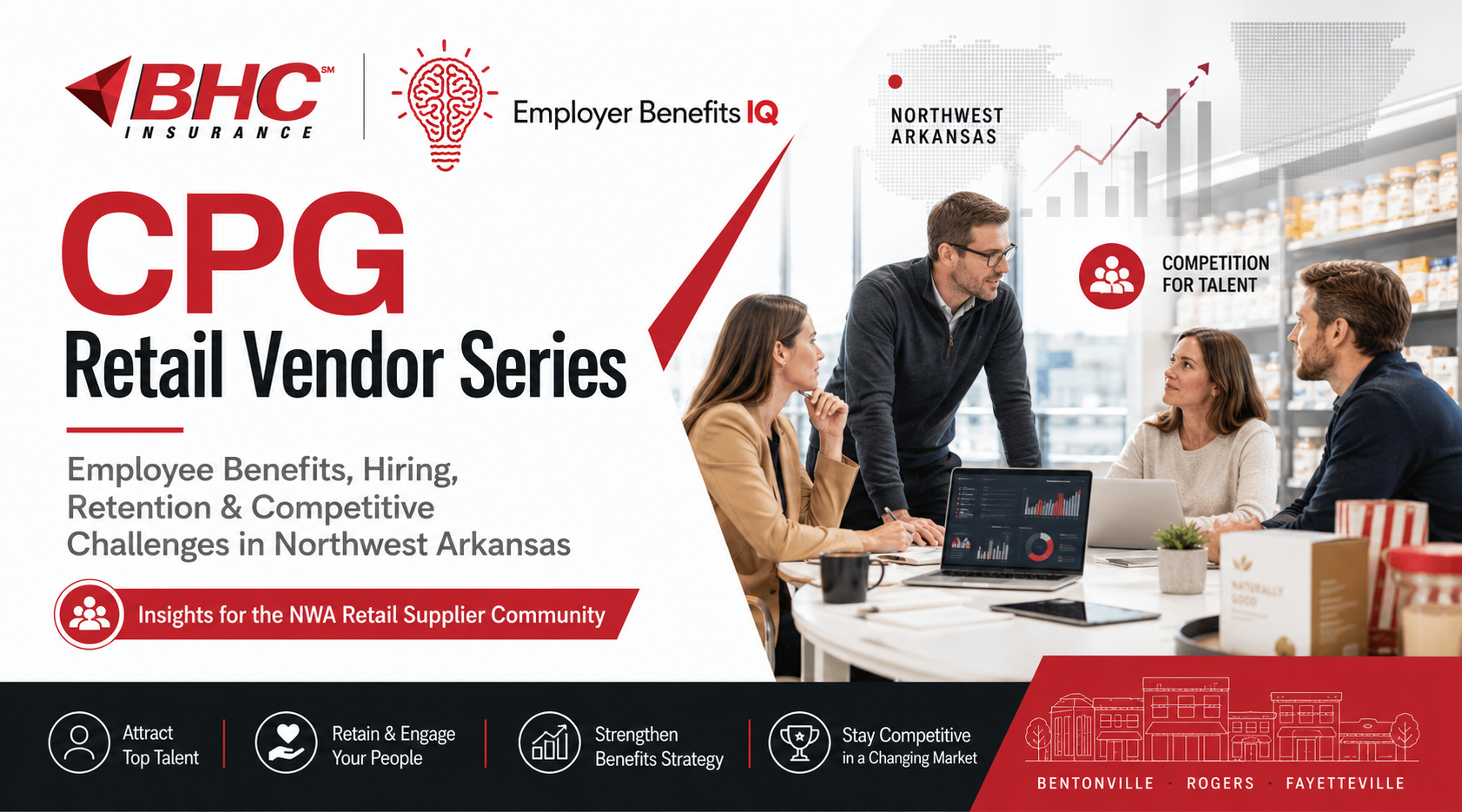
If you work in the Northwest Arkansas retail supplier community, you already understand competition.
You compete for shelf space. You compete for digital placement. You compete on price, innovation, category performance, supply chain execution, retail media, data, and relationships. You are constantly being asked to do more, move faster, find efficiencies, protect margin, and prove your value.
But another competition is taking place in Northwest Arkansas that may ultimately be just as important to your business.
The competition for people.
And I think the employee benefits conversation inside the retail supplier community needs to change because of it.
Northwest Arkansas has become one of the most unique business ecosystems in the country. Hundreds of CPG companies, retail suppliers, service providers, data and analytics firms, logistics companies, agencies, technology companies, and consultants have established teams here to support Walmart and Sam’s Club. At the same time, the region continues to grow at an extraordinary pace. The Fayetteville-Springdale-Rogers metro added nearly 15,000 people from 2024 to 2025 alone—roughly 40 new residents every day—and has grown approximately 41% since 2010.
That growth is exciting, but it doesn't eliminate the talent problem. The Northwest Arkansas Council recently noted that the region continues to add jobs faster than it can supply talent.
That dynamic is particularly interesting inside the supplier community because the competition for an employee isn't always coming from across the country.
Sometimes it is coming from across the street.
A strong category analyst can move from one supplier to another without leaving Bentonville. A talented sales leader can move to another brand while keeping the same retailer relationships and industry knowledge. Someone in shopper marketing, supply chain, retail media, replenishment, finance, analytics, or e-commerce may have dozens of potential employers within the same relatively small geographic area.
They don't have to change industries.
They don't necessarily have to relocate.
They may not even have to change their commute very much.
That creates a very different employee retention problem than what most employers experience.
And then there is Walmart itself.
Supplier companies aren't just competing against one another for talent. They are operating next to one of the largest employers in the world, an organization continuing to make significant investments in employee development, career pathways, wages, benefits, education, and workplace experience. Walmart's new Bentonville campus includes amenities such as on-site childcare, a major health and fitness center, food options, collaborative workspaces, and other features designed around the employee experience.
A 75-person or 150-person supplier office probably isn't going to recreate a 350-acre corporate campus.
It shouldn't try.
But it does need to understand the competitive environment in which its employees are making career decisions.
That is where I believe benefits strategy becomes much more important.
Too many employers still look at employee benefits primarily as an annual insurance transaction. The renewal comes in, HR and finance look at the increase, the broker negotiates with the carrier, maybe deductibles or employee contributions get adjusted, open enrollment happens, and everyone moves on until next year.
That approach is becoming increasingly difficult to defend.
Employer healthcare costs are projected to increase another 9.5% in 2027, pushing average employer health benefit costs above $19,000 per employee. That follows several consecutive years of significant increases.
For a retail supplier operating on tight margins, healthcare isn't just an HR expense anymore.
It is a P&L issue.
But simply pushing more of that cost onto employees creates another problem. The benefit becomes less valuable at exactly the same time you are asking it to help attract and retain people.
That's the trap.
Employers can't continue absorbing unlimited healthcare inflation.
Employees can't continue absorbing unlimited payroll deductions, deductibles, copays, and out-of-pocket expenses.
And companies still need a benefits package capable of competing for talent.
The answer isn't necessarily spending more money.
The answer is getting much smarter about where the money is going.
That may mean looking at how the health plan is financed differently. It may mean analyzing pharmacy contracts, high-cost claims, networks, stop-loss, specialty drugs, care navigation, direct primary care, virtual care, mental health, or centers of excellence. It may mean reevaluating employer contributions or introducing benefits employees actually value rather than simply adding more programs.
It also means recognizing that benefits extend far beyond medical insurance.
Today's employee value proposition includes compensation, healthcare affordability, paid time off, parental benefits, flexibility, career development, financial wellbeing, disability protection, mental health resources, childcare considerations, voluntary benefits, workplace culture, leadership, and whether employees can actually understand and use the benefits being offered to them.
For a Northwest Arkansas supplier, another complication exists.
Many of these organizations are intentionally lean.
You may have 50, 100, 200, or 500 employees competing for some of the same talent as companies with tens of thousands of employees and enormous HR infrastructures.
Your HR leader may be managing recruiting, payroll, benefits, compliance, employee relations, culture, onboarding, performance management, and everything else that falls under "people."
That means the solution cannot simply be **more benefits**.
It has to be a better benefits strategy.
Over the next several weeks, I'm going to dig into this challenge through a five-part series specifically focused on CPG companies and retail suppliers operating in Northwest Arkansas.
Part 1 — The Northwest Arkansas Talent War: Who Are You Really Competing Against?
We will look at what makes recruiting inside the Northwest Arkansas supplier ecosystem so unusual. Retail-ready talent is incredibly valuable, but also highly mobile. We'll talk about competition between suppliers, Walmart and Sam's Club, agencies, technology companies, emerging businesses, and increasingly remote employers outside Arkansas.
More importantly, we'll look at why benchmarking your benefits only against employers of a similar size may completely miss the point.
Your employees don't necessarily compare you with companies that look like you.
They compare you with the companies that want to hire them.
Part 2 — Benefits Are Compensation: The Healthcare Affordability Problem
Healthcare may be one of the largest expenses on your P&L outside of payroll, yet many employers have remarkably little visibility into what is actually driving the cost.
We will break down why healthcare costs continue rising, where the money is going, and why simply changing carriers or increasing deductibles isn't a long-term strategy.
We'll also explore how employers can begin controlling healthcare costs without destroying the perceived value of the benefit for employees.
Part 3 — Why Good Employees Leave: Rethinking the Employee Value Proposition
Compensation matters.
But compensation isn't the entire equation.
We'll look at flexibility, career development, management, paid time off, parental benefits, mental health, financial wellbeing, healthcare affordability, workplace experience, and the other factors that influence whether someone stays or answers the next recruiter who calls.
The goal isn't to offer every benefit available.
It is to understand which benefits actually matter to the people you're trying to attract and retain.
Part 4 — The Small-Team Problem: Competing Like a Large Employer Without Becoming One
This may be one of the biggest challenges facing supplier organizations.
How does a 100-person company provide a sophisticated employee experience without a massive HR department?
How do you manage benefits, compliance, communication, enrollment, employee advocacy, data, vendors, and cost containment without adding layers of administrative complexity?
We'll look at ways smaller and middle-market supplier organizations can leverage technology, outside resources, alternative funding strategies, employee advocacy, better communication, and smarter vendor partnerships to create an experience that feels much larger than the organization itself.
Part 5 — Building the High-Performing Retail Supplier Benefits Strategy
The final article will bring everything together.
We'll outline what I believe a modern employee benefits strategy should look like for a Northwest Arkansas retail supplier—from benchmarking and healthcare analytics to recruiting, retention, funding strategy, employee communication, benefits administration, compliance, and long-term planning.
If one of our best employees gets a call tomorrow from another supplier down the road, have we given them enough reasons to stay?
That is the conversation I want to have with the Northwest Arkansas retail supplier community.
This isn't about buying more insurance.
It isn't about adding another wellness program nobody uses.
And it isn't about copying whatever the company next door happens to be doing.
It's about treating employee benefits, healthcare strategy, and the employee experience as part of the business's competitive strategy.
Because in Northwest Arkansas, the battle for talent is happening every day.
And just like the battle for shelf space, companies that understand the environment, use better information, and develop a deliberate strategy will have an advantage.
If you're a leader, CFO, HR professional, or benefits decision-maker inside the Northwest Arkansas CPG and retail supplier community, I'd like to hear what you're seeing. What has become harder about recruiting and retaining people? Which positions are the most difficult to fill? What are employees asking for today that they weren't asking for five years ago?
Those conversations are exactly what this series is intended to start.
Questions about this topic? I'm available for consulting engagements across Northwest Arkansas and beyond.
Sources & Further Reading
- Northwest Arkansas Council: Workforce and Talent Report — Regional data on workforce growth, in-migration, and the competitive employment environment for CPG and retail supplier firms.
- KFF Employer Health Benefits Survey 2024 — National benchmark for employer health plan costs and employee contributions by firm size.
- SHRM: Talent Acquisition Benchmarking Report 2024 — Data on time-to-fill, cost-per-hire, and the role of benefits in candidate decision-making.
- Bureau of Labor Statistics: Job Openings and Labor Turnover Survey (JOLTS) — National and regional data on voluntary separations and quit rates — context for the talent retention challenge.
- EBRI: Workers' Views on Health Care Costs and Coverage (2024) — Employee survey data on how health benefits influence job choice and retention.
About the Author
Corry Hull, REBC®, CSFS®
VP of Employee Benefits · BHC Insurance
Corry Hull, REBC® CSFS®, is VP of Employee Benefits at BHC Insurance and the founder of Employer Benefits IQ (www.employerbenefitsiq.com). He is a Certified Health Rosetta Advisor — one of fewer than 200 nationwide — and a multi-year presenter at United Benefit Advisors (UBA) national conferences. He specializes in self-funded health plan design, PBM contract strategy, stop-loss structuring, group medical captives, and ACA/ERISA compliance for mid-market employers. His work has been recognized by Health Rosetta (Rosie Award, 2026), UBA (Producer Peak Performer, 2025–2024), and BHC Insurance (Producer of the Year, 2021–2025). His employer-education content has been referenced in BenefitsPro and cited within the Health Rosetta advisor community. All consulting and brokerage compensation is fully disclosed.