
The Health Rosetta Framework: A Better Way for Employers to Buy Healthcare
For most employers, healthcare is one of the largest expenses on the income statement.

VP of Employee Benefits · BHC Insurance · Independent Benefits Consultant
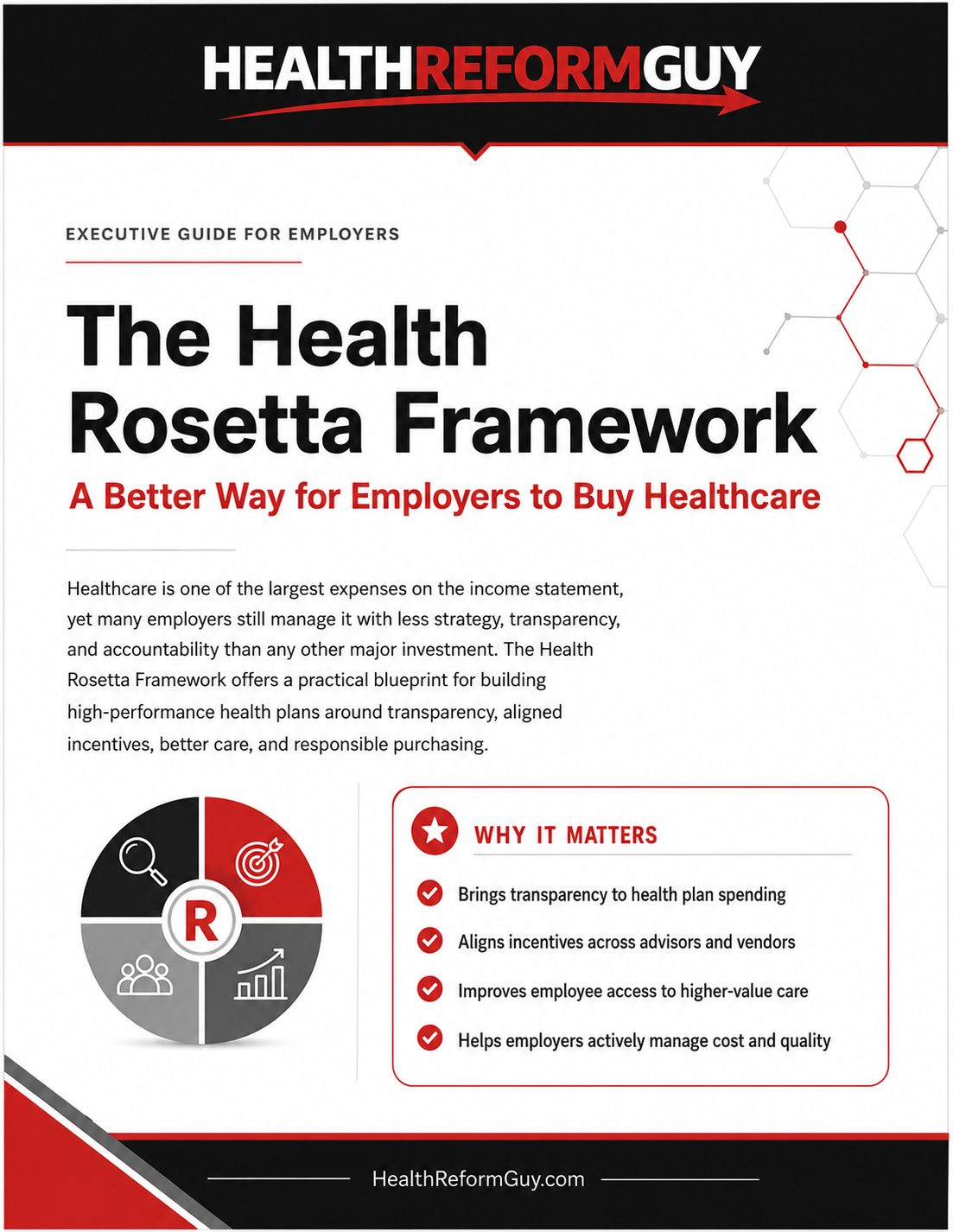
For most employers, healthcare is one of the largest expenses on the income statement.
Yet it is often managed with less strategy, transparency, and accountability than almost any other major business investment.
Employers carefully evaluate suppliers, negotiate contracts, measure operational performance, and hold vendors accountable in nearly every other area of their organization. But when it comes to healthcare, many continue to accept annual renewals, limited data, confusing contracts, and rising costs as unavoidable.
The Health Rosetta Framework challenges that mindset.
It provides employers with a practical blueprint for building high-performance health plans around transparency, aligned incentives, better care, and responsible purchasing. Rather than treating healthcare inflation as something employers must simply absorb, the framework encourages plan sponsors to actively manage healthcare as a controllable business expense.
The Problem Is Not Simply the Cost of Healthcare
Healthcare is expensive, but the larger problem is that it is frequently purchased through a fragmented system filled with misaligned incentives.
Employers may have a broker, insurance carrier, third-party administrator, pharmacy benefit manager, network, stop-loss carrier, navigation platform, wellness vendor, and several point solutions. Each organization may perform its individual function, but that does not necessarily mean the pieces operate together as a coordinated strategy.
In many health plans, employers do not clearly understand:
How every vendor is compensated Which organizations retain rebates or other revenue Whether claims are being paid appropriately How employees are directed to high-quality care What is driving increases in medical and pharmacy spending Whether vendors are financially rewarded for reducing costs Whether plan contracts protect the employer’s interests
The result is often a collection of products rather than a functioning healthcare strategy.
Health Rosetta describes its framework as an evolving, expert-sourced blueprint based on the practices of successful healthcare purchasers. It is intended to help employers create a coherent system instead of layering disconnected solutions onto a poorly designed foundation.
The Health Rosetta Is a Framework, Not a Product
One of the most important things to understand is that the Health Rosetta is not an insurance company, health plan, captive, TPA, PBM, or vendor.
It does not prescribe one identical solution for every employer.
It is a framework for evaluating how healthcare is financed, administered, purchased, and delivered. The right strategy will vary based on an employer’s size, geography, employee population, financial objectives, risk tolerance, claims experience, and organizational culture.
This distinction matters.
Employers should not be searching for a single “silver bullet” capable of fixing the entire health plan. Sustainable improvement usually comes from redesigning the underlying system and aligning each component around a common set of objectives.
The Health Rosetta Framework organizes that work into eight interconnected components:
Transparent, aligned advisors High-performance plan design and risk management Independent, active plan administration Individual stewardship Value-based primary care Transparent open networks Major specialties and outlier-patient management Transparent pharmacy benefits
These components are designed to work together and may be implemented sequentially over several years rather than all at once.
Transparency Must Come First
Employers cannot effectively manage what they cannot see.
Transparency begins with understanding how advisors, administrators, carriers, PBMs, networks, and other vendors are compensated. It also means having access to contracts, claims information, pharmacy data, performance reports, and the methodology used to calculate fees and savings.
This is not about assuming every vendor is acting improperly. It is about creating a structure in which employers can independently verify that vendor incentives align with the interests of the plan and its members.
Health Rosetta’s Benefits Advisor Code of Conduct is built around three foundational expectations: transparency, expertise, and alignment. It calls for disclosure throughout healthcare financing, including how advisors, insurance companies, PBMs, and providers are paid.
Transparency should not be viewed as a negotiating tactic. It is a basic requirement for responsible plan governance.
A sophisticated employer would never accept a major supplier relationship without knowing the supplier’s fees, ownership relationships, performance standards, or contractual obligations. Healthcare vendors should not be treated differently.
Plan Design Should Guide Employees Toward Better Care
Traditional health plan design often focuses primarily on deductibles, copayments, coinsurance, and out-of-pocket limits.
Those decisions matter, but high-performance plan design goes further.
It considers how the plan encourages employees to use high-quality, cost-effective care. Instead of applying the same cost-sharing to every provider and service, employers can create incentives that make high-value decisions easier for employees.
That might include:
No-cost access to high-quality primary care Reduced cost-sharing for selected centers of excellence Bundled pricing for surgeries and major procedures Support for employees navigating cancer or complex diagnoses Lower-cost access to clinically appropriate medications Financial incentives for using high-quality imaging or surgical facilities
The goal is not to shift more cost to employees. It is to help employees avoid unnecessary cost while improving the quality of their care.
A plan that merely increases deductibles every year may reduce the employer’s short-term exposure, but it does not address the actual price, quality, or delivery of healthcare. In many cases, it simply transfers more financial pressure to employees and their families.
Primary Care Should Be the Front Door
Strong primary care is one of the most important foundations of a high-performing health plan.
Employees need a trusted healthcare relationship that can help them manage chronic conditions, receive preventive care, avoid unnecessary emergency-room visits, and navigate the broader healthcare system.
The traditional fee-for-service model does not always support that relationship. Physicians are often pressured to see more patients in less time, while employees struggle with scheduling, access, and cost.
Value-based primary care models, including direct primary care and advanced primary care arrangements, attempt to change those incentives. Providers are given more time with patients and are rewarded for access, coordination, and health outcomes rather than simply for producing more billable services.
Health Rosetta identifies properly incentivized primary care as the frontline defense against unnecessary downstream spending.
Primary care alone will not solve every healthcare problem, but without an effective front door, employees are left to navigate an extraordinarily complicated system on their own.
Employees Need Stewardship, Not Another App
Healthcare navigation is frequently treated as a technology problem.
Employers introduce a new app, distribute login instructions, and hope employees will independently research hospitals, compare pricing, coordinate treatment, and challenge medical bills.
That expectation is unrealistic.
Healthcare decisions are often made when people are frightened, sick, in pain, or caring for a family member. Employees need access to trusted advocates who can help them understand their options and make informed decisions.
Individual stewardship may include nurse advocates, benefits concierges, care coordinators, clinical support, claims assistance, and proactive outreach to employees facing complex conditions.
The objective is not simply to give employees more information. It is to help them act on that information.
High-performance plans should make the best healthcare decision the easiest decision.
High-Cost Claims Require Active Management
A relatively small number of patients and services frequently account for a significant portion of an employer’s healthcare spending.
Cancer treatment, specialty medications, musculoskeletal procedures, cardiac care, dialysis, gene therapies, and other complex conditions can quickly produce substantial claims.
These cases cannot be managed effectively through a generic discount arrangement alone.
Employers need strategies for directing members to high-quality providers, reviewing treatment plans, evaluating appropriate sites of care, negotiating bundled arrangements, and coordinating with stop-loss coverage.
The purpose is not to deny necessary treatment. It is to ensure that employees receive excellent care while protecting families and the health plan from unreasonable pricing, preventable complications, and poorly coordinated services.
The Health Rosetta Framework specifically recognizes major specialties and outlier-patient management as a core component of a high-performance plan.
Pharmacy Benefits Must Be Managed Independently
Pharmacy has become one of the fastest-growing and least transparent areas of employer healthcare spending.
Employers may encounter spread pricing, retained rebates, administrative fees, formulary incentives, specialty-pharmacy markups, manufacturer revenue, and contract terms that make it difficult to determine the true net cost of a medication.
Employers should understand:
The full flow of pharmacy dollars The treatment of rebates and manufacturer revenue The difference between ingredient cost and net plan cost The management of specialty medications The effect of formulary decisions The ownership relationships among the PBM, pharmacy, insurer, and other vendors The employer’s right to audit claims and contracts
Health Rosetta’s transparent pharmacy component is intended to eliminate spread pricing, hidden fees, and rebate-driven conflicts that may not serve the plan or its members.
Better Benefits Require Better Governance
The Health Rosetta Framework is ultimately about more than individual cost-containment strategies.
It is about governance.
Employers have a responsibility to understand how plan assets are being spent, how vendors are selected, how compensation is structured, and whether decisions are producing measurable value for employees.
That requires regular reporting, documented processes, independent advice, meaningful contract review, and a willingness to challenge longstanding arrangements.
The Health Rosetta Plan Sponsor Bill of Rights emphasizes fiduciary protection, transparent relationships, independence, access to relevant information, and comprehensive reporting of costs and cost drivers.
This is especially important as employers face increased scrutiny around ERISA fiduciary responsibilities and the management of health plan expenses.
Good governance is not about creating more paperwork. It is about demonstrating that the employer followed a prudent process and made decisions in the best interests of the plan and its participants.
Implementation Should Be Strategic, Not Disruptive
Employers do not need to replace every vendor or redesign the entire health plan in a single year.
In fact, trying to implement too much too quickly can create confusion, operational challenges, and employee frustration.
A more effective approach is to establish a multi-year strategy.
The first year may focus on data access, advisor transparency, contract review, plan documents, and vendor accountability. The next phase may address pharmacy, primary care, navigation, or high-cost claims. Additional components can then be introduced as the organization builds internal support and develops the ability to measure results.
The framework is modular by design, and Health Rosetta describes the components as capable of being implemented sequentially over a two- to three-year period.
The key is to begin with a clear destination.
Without a long-term strategy, employers often return to the same renewal process every year—reacting to increases, adjusting contributions, changing deductibles, and hoping the following year will be better.
Healthcare Is Not Unmanageable
The most powerful idea behind the Health Rosetta Framework is that employers are not powerless.
Healthcare is complicated, but it is not beyond management.
Employers can demand better data. They can negotiate stronger contracts. They can align vendor compensation. They can improve primary care. They can manage pharmacy spending. They can guide employees to higher-quality providers. They can create a better experience for employees while protecting the financial health of the organization.
Health Rosetta evaluates its components against the Quadruple Aim: improving the patient experience, improving the care-team experience, improving health outcomes, and lowering the total cost of care. These goals should reinforce one another rather than be treated as competing priorities.
That is what makes the framework so important.
It moves the employer health plan away from passive renewal management and toward intentional healthcare purchasing.
The future of employee benefits will not be defined by which organization negotiates the largest network discount or presents the most attractive renewal spreadsheet.
It will belong to employers that understand their data, control their contracts, align incentives, actively manage risk, and build healthcare strategies around the needs of their employees.
The Health Rosetta Framework gives employers a blueprint for doing exactly that.
Questions about this topic? I'm available for consulting engagements across Northwest Arkansas and beyond.
Sources & Further Reading
- Health Rosetta: Framework Overview and Employer Implementation Guide — Primary source for the Health Rosetta framework components discussed throughout the article.
- KFF Employer Health Benefits Survey 2024 — Benchmark data on employer health plan costs — the problem the Health Rosetta framework is designed to address.
- PBGH: High-Performance Health Plan Principles — Employer coalition guidance on the components of a high-performing health plan — aligned with the Health Rosetta framework.
- Health Affairs: Primary Care Investment and Total Cost of Care — Research on the relationship between primary care access and total health plan cost — supports the "primary care as the front door" component.
- Dave Chase: The CEO's Guide to Restoring the American Dream (Health Rosetta Press, 2017) — Foundational text for the Health Rosetta framework — the employer-facing case for a fundamentally different approach to buying healthcare.
The tools below are built for exactly what this article covers. Free to use — no login required.
Benefits Plan Checkup
Free 5-step scored assessment of your plan across cost, compliance, pharmacy, vendor management, and employee experience.
Self-Funding Readiness Assessment
Answer 20 questions to get a scored readiness assessment and a recommended path forward.
Benchmark Analyzer
Compare your plan's cost, design, and pharmacy spend against industry benchmarks by size and sector.
About the Author
Corry Hull, REBC®, CSFS®
VP of Employee Benefits · BHC Insurance
Corry Hull, REBC® CSFS®, is VP of Employee Benefits at BHC Insurance and the founder of Employer Benefits IQ (www.employerbenefitsiq.com). He is a Certified Health Rosetta Advisor — one of fewer than 200 nationwide — and a multi-year presenter at United Benefit Advisors (UBA) national conferences. He specializes in self-funded health plan design, PBM contract strategy, stop-loss structuring, group medical captives, and ACA/ERISA compliance for mid-market employers. His work has been recognized by Health Rosetta (Rosie Award, 2026), UBA (Producer Peak Performer, 2025–2024), and BHC Insurance (Producer of the Year, 2021–2025). His employer-education content has been referenced in BenefitsPro and cited within the Health Rosetta advisor community. All consulting and brokerage compensation is fully disclosed.