
The Employer Healthcare Cost Crisis: Where Is All the Money Going?
For most employers, healthcare has quietly become one of the largest expenses on the P&L outside of payroll.

VP of Employee Benefits · BHC Insurance · Independent Benefits Consultant
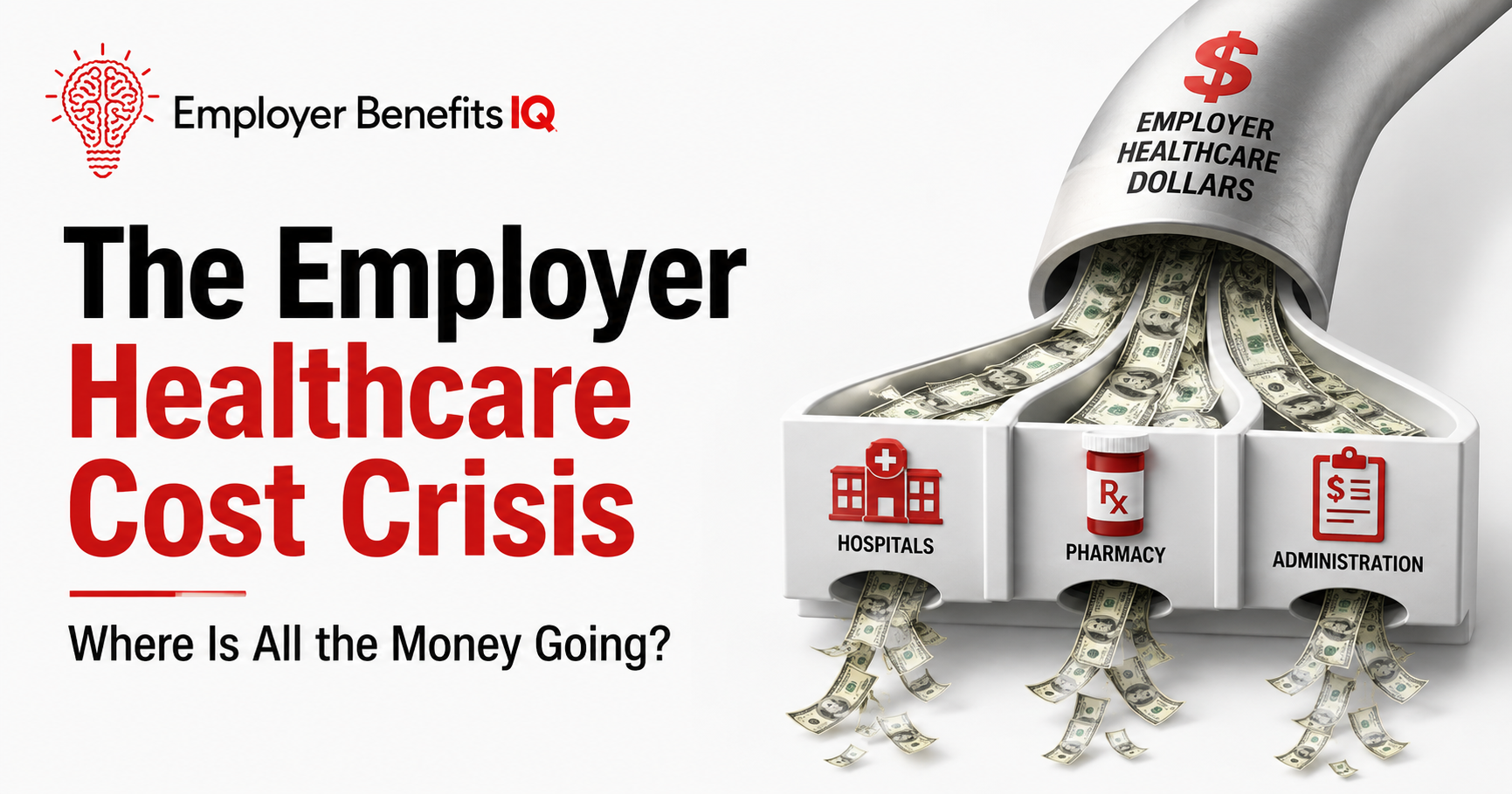
For most employers, healthcare has quietly become one of the largest expenses on the P&L outside of payroll. Remarkably, it may also be one of the least understood.
If the cost of raw materials increased 10% or 12% every year, nobody would just shrug and accept it. If freight, utilities, or technology expenses kept climbing at that pace, leadership would dig into the numbers, challenge vendors, and figure out exactly what was driving the increase.
Healthcare is different.
Every year, employers get handed another renewal. Costs are up. Medical trend is high. Pharmacy is up. Large claims were bad. Utilization increased. The explanations change a little, but the outcome usually does not. The employer absorbs part of the increase, shifts some of it to employees, changes deductibles or contributions, and hopes next year will be better.
Then twelve months later, we do it all over again.
At some point, we have to admit this isn't working.
The real employer healthcare cost crisis is not simply that healthcare is expensive. We all know it is expensive. The bigger issue is that employers are spending millions of dollars inside a system they often cannot clearly see, measure, or control.
That is a problem.
Behind every health plan is an incredibly complicated financial ecosystem. Hospitals, health systems, physicians, insurance carriers, pharmacy benefit managers, drug manufacturers, specialty pharmacies, networks, TPAs, stop-loss carriers, consultants, brokers, navigation companies, and dozens of other vendors are all involved somewhere along the way.
Every one of them touches the healthcare dollar.
Where is all the money going?
That is the question I want to explore in this series, because once you start following the money, a lot of things look different.
Take hospital pricing.
Employers are constantly told how much their carrier or network "discounted" a hospital bill. Maybe the discount was 50%. Maybe it was 60%. Maybe it was 70%.
That sounds great until you realize the discount is often being applied to a hospital's own inflated billed charge.
A big discount does not necessarily mean you got a good price. Sometimes it just means you got a big discount off a bad price.
There is a huge difference.
Healthcare may be the only major purchase an employer makes where they can spend millions of dollars and still have very little idea what they actually paid compared to the service's real market value.
Pharmacy is another area where the math gets complicated quickly.
Prescription drug costs continue to climb, driven in part by specialty medications, biologics, cancer drugs, and now GLP-1 medications. But the pharmacy system is also built around rebates, discounts, formularies, spread pricing, and contracts that most employers never see in full.
For years, employers have been trained to focus on the size of the rebate.
I think that is the wrong question.
The better question is: **What was the drug's actual net cost to the plan? ****
A $5,000 rebate does not mean much if the plan paid $20,000 for a medication that could have been managed differently for a fraction of the cost.
Then there is the administrative side of healthcare.
We have built an enormous machine around processing, managing, reviewing, approving, billing, coding, negotiating, and administering healthcare. Some of that is necessary. There is no question about that.
But employers should still ask how much of every healthcare dollar is actually paying for care, and how much is paying for everything wrapped around it.
The complexity itself has become expensive.
Chronic disease is another part of the equation that does not get enough attention.
Diabetes, obesity, cardiovascular disease, musculoskeletal conditions, cancer, and behavioral health issues are not one-time claims problems. They create long-term cost pressure that can build for years.
Yet many employers still spend almost all of their energy on the renewal instead of asking a much bigger question: are we actually improving the health trajectory of our population?
If the answer is no, then we are not really managing healthcare costs. We are just financing them.
And then we get to what I believe may be the most important issue of all: incentives.
Employers want lower healthcare costs. Employees want high-quality, affordable care.
But many organizations inside the healthcare system make more money when healthcare spending goes up.
That does not mean those organizations are bad. It does mean employers need to understand how everyone involved in their plan is paid and what those payment models encourage.
Hospitals generally earn more when they deliver more services. Drug manufacturers earn more when expensive medications are used. Some PBM models have historically benefited from higher drug prices and larger rebates. Insurance carrier revenue can grow as premiums increase. Many vendors are paid based on a percentage of spending rather than how much spending they eliminate.
That matters because incentives drive behavior.
If the system rewards higher spending, we should not be surprised when spending continues to rise.
This is why I believe employers need to stop treating healthcare as simply an insurance problem.
It is a purchasing problem. It is a data problem. It is a contracting problem. It is a supply-chain problem. It is a population health problem. And increasingly, it is a fiduciary and financial-management problem.
The annual renewal should be the result of your healthcare strategy.
It should not be the strategy.
That may sound like a small distinction, but it changes everything.
Every dollar an employer overspends on healthcare is a dollar that cannot be used somewhere else in the business. It cannot go toward wages, new hires, equipment, technology, expansion, or investment.
And when the solution to higher healthcare costs is simply raising employee contributions or deductibles, the cost has not actually been reduced.
It has just been moved.
That is not cost containment. That is cost shifting.
Over the next five parts of this series, I am going to dig into where employer healthcare dollars are actually going and why costs continue to rise.
We will look at hospital pricing and medical claims. We will dig into pharmacy spending and PBM economics. We will look at administrative waste and complexity. We will examine chronic conditions and their long-term impact on employer plans. Finally, we will talk about the misaligned incentives throughout the healthcare system and why so many seem to reward higher costs instead of better outcomes.
These are conversations more employers need to be having.
We spend far too much money on healthcare to settle for vague explanations about "trend."
If your company is spending hundreds of thousands or millions of dollars every year on healthcare, you should be able to explain where that money is going, who is getting paid, what is driving the increases, and what you are doing about it.
If you cannot, that is where the conversation needs to start.
So I will end with a question.
If I asked you today to explain exactly where your organization's healthcare dollars are going, could you do it?
I would genuinely like to hear what employers, CFOs, HR leaders, brokers, consultants, and benefits professionals are seeing.
What is driving your costs right now? Hospital claims? Pharmacy? Large claimants? Chronic conditions? Specialty drugs? Something else?
Leave a comment or send me a question. I want this series to be a conversation, not just another set of articles about healthcare costs.
Because before employers can solve the healthcare cost crisis, we have to understand where the money is actually going.
Questions about this topic? I'm available for consulting engagements across Northwest Arkansas and beyond.
Sources & Further Reading
- KFF 2025 Employer Health Benefits Survey — Annual benchmark on employer-sponsored health plan costs and trends
- RAND Hospital Price Transparency Study — Commercial vs. Medicare hospital pricing analysis
- PwC Health Research Institute — Medical Cost Trend — Annual medical cost trend projections for employer plans
- Mercer National Survey of Employer-Sponsored Health Plans — Employer health plan cost and design benchmarking
About the Author
Corry Hull, REBC®, CSFS®
VP of Employee Benefits · BHC Insurance
Corry Hull, REBC® CSFS®, is VP of Employee Benefits at BHC Insurance and the founder of Employer Benefits IQ (www.employerbenefitsiq.com). He is a Certified Health Rosetta Advisor — one of fewer than 200 nationwide — and a multi-year presenter at United Benefit Advisors (UBA) national conferences. He specializes in self-funded health plan design, PBM contract strategy, stop-loss structuring, group medical captives, and ACA/ERISA compliance for mid-market employers. His work has been recognized by Health Rosetta (Rosie Award, 2026), UBA (Producer Peak Performer, 2025–2024), and BHC Insurance (Producer of the Year, 2021–2025). His employer-education content has been referenced in BenefitsPro and cited within the Health Rosetta advisor community. All consulting and brokerage compensation is fully disclosed.