
Part 4: Chronic Conditions — The Long-Tail Driver of Employer Healthcare Spending
When an employer has a bad healthcare year, everyone immediately looks at the largest claims.

VP of Employee Benefits · BHC Insurance · Independent Benefits Consultant
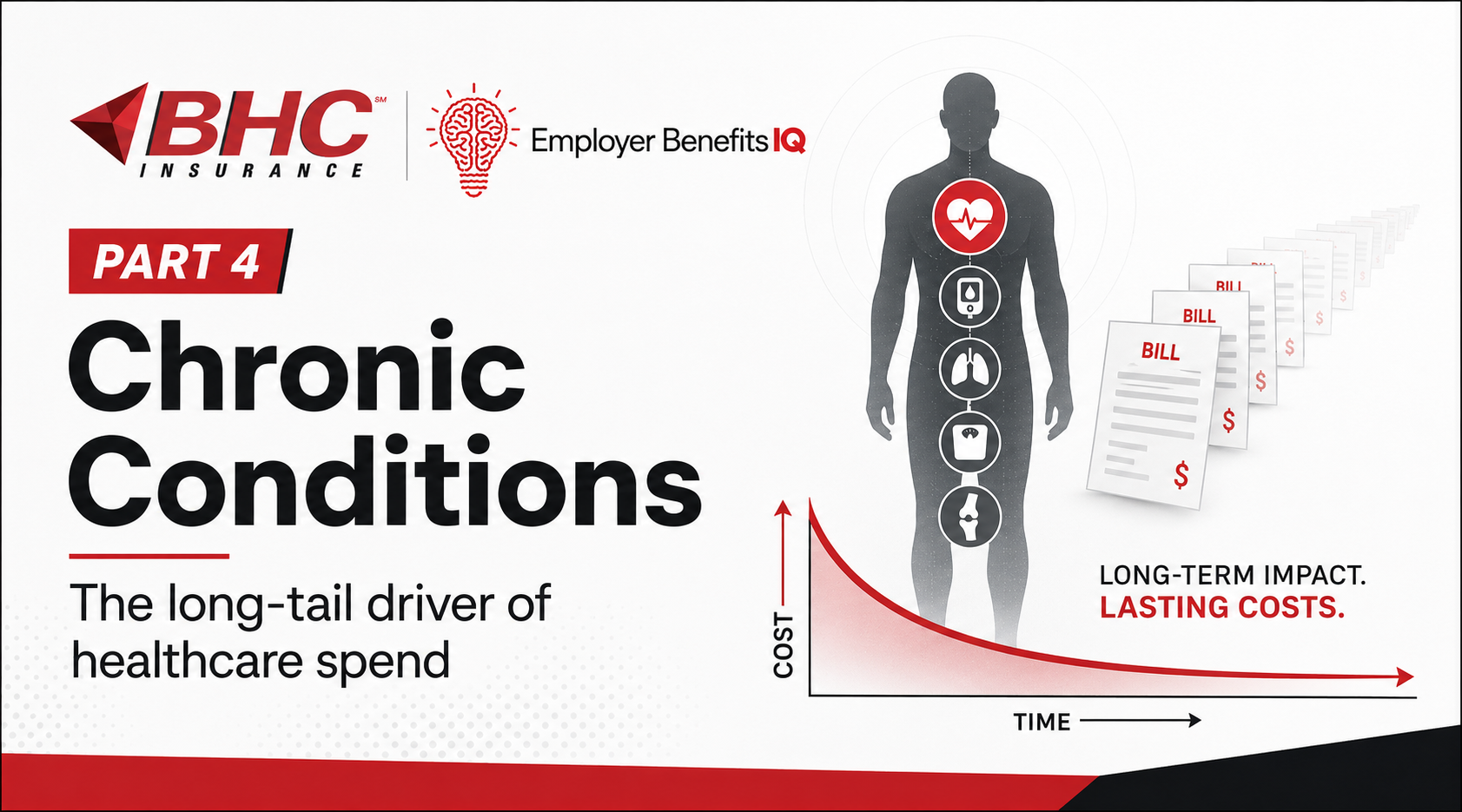
When an employer has a bad healthcare year, everyone immediately looks at the largest claims. A cancer diagnosis. A major surgery. A premature birth. A transplant. A catastrophic accident. Those claims get attention because the numbers are big and easy to see.
But I think employers spend too much time looking at the claims that explode all at once and not enough time looking at the conditions quietly building underneath the plan year after year.
Diabetes, obesity, cardiovascular disease, hypertension, musculoskeletal conditions, behavioral health, and chronic kidney disease do not always show up as one giant claim. More often, they show up a little at a time. Prescription drugs. Physician visits. Lab work. Imaging. Physical therapy. Emergency room visits. Surgeries. Hospitalizations. Disability. Time away from work.
Then one condition starts contributing to another.
Obesity can increase the risk of diabetes, cardiovascular disease, sleep apnea, and joint problems. Diabetes that is poorly controlled can eventually lead to kidney disease, cardiovascular complications, neuropathy, and hospitalization. Chronic pain can lead to inactivity, weight gain, mental health challenges, and additional medication use. Behavioral health issues can make almost every other chronic condition harder to manage.
The costs build over time.
That is why I think chronic disease needs to be viewed differently inside an employer health plan. It is not just a claims problem. It is long-term financial risk.
If you are responsible for an employer health plan, you are not only paying for what happened last year. You are financing the health trajectory of your employee population.
That is a very different way to think about benefits.
Too many healthcare strategies still begin and end with the renewal. We look at last year's claims, negotiate with the carrier, adjust deductibles, change contributions, maybe add another program, and then wait twelve months to see what happens.
Meanwhile, the underlying health of the population may be moving in the wrong direction.
If diabetes prevalence is increasing, obesity rates are climbing, employees are delaying care because of cost, blood pressure is poorly controlled, and people do not have good access to primary care, changing insurance carriers is not going to solve the problem.
You might get a better renewal.
You probably did not change the direction of the healthcare spend.
That difference matters.
Diabetes is a good example. An employer may see diabetes medications, physician visits, lab work, supplies, and occasional hospital claims scattered across different reports. Those costs can look unrelated. They are not.
The real issue is whether the condition is being managed well.
Someone with well-controlled diabetes, appropriate medication, and regular primary care can have a completely different healthcare trajectory than someone whose diabetes is poorly managed until they end up in the emergency room or hospital.
The same thing is true with hypertension. High blood pressure is relatively inexpensive to manage when it is identified early and treated appropriately. Left uncontrolled, it can contribute to heart attacks, strokes, kidney disease, and other very expensive events.
That is where I think the traditional insurance mindset falls short.
Insurance is designed to pay claims.
A high-performing employer health plan should also be designed to keep manageable conditions from turning into larger claims.
Those are two different things.
Obesity has probably brought this conversation into focus more than anything else because of the growth of GLP-1 medications. Employers are trying to balance legitimate clinical value with a very real financial concern. These medications can create meaningful health improvements for the right people, but broad utilization can also create a significant pharmacy expense very quickly.
The easiest answers tend to be at the extremes. Cover everything or cover nothing.
I do not think either approach is especially strategic.
The better question is what the employer is actually trying to accomplish.
If you are going to cover GLP-1 medications for weight management, what does the rest of the strategy look like? Are employees receiving clinical oversight? Nutrition support? Behavioral support? Are outcomes being measured? Is continued use tied to appropriate clinical criteria? Are we looking at whether diabetes risk, cardiovascular risk, musculoskeletal issues, and other related conditions improve over time?
On the other side, if an employer excludes these medications strictly because they are expensive, what is the long-term cost of doing nothing about the underlying condition?
That is a much more important conversation than simply asking whether the drug is expensive.
Musculoskeletal conditions are another major area employers should pay attention to. Back pain, knee problems, shoulder injuries, arthritis, and other MSK conditions can drive a surprising amount of medical spending and lost productivity.
The obvious costs are things like imaging, physical therapy, injections, and surgery. But there are other costs that are harder to see. Time away from work. Reduced productivity. Repeated office visits. Opioid use. Unnecessary imaging. Surgery that might have been avoided with earlier intervention.
An employee can generate musculoskeletal claims for years without ever appearing on a large-claim report.
That is why looking at the ten largest claims and calling it a healthcare strategy gives you a very incomplete picture.
Cancer is different because it can become a catastrophic claim very quickly, but even there, the employer's strategy still matters. Early detection matters. Where treatment happens matters. The oncologist matters. The site of infusion matters. Specialty drug pricing matters. Second opinions matter. Access to a Center of Excellence can matter.
The goal is not to interfere with the physician-patient relationship.
The goal is to make sure an employee going through one of the most difficult periods of their life has access to high-quality care, better information, and support navigating a system that can be incredibly difficult to understand.
Behavioral health deserves the same attention.
For years, employers tended to treat mental health as something separate from medical claims.
It really is not.
Anxiety, depression, stress, substance use, and other behavioral health conditions can affect medication adherence, chronic disease management, absenteeism, disability, productivity, and overall healthcare utilization.
Someone dealing with severe depression may also be trying to manage diabetes. Someone dealing with chronic pain may also be dealing with anxiety. Someone who has just received a cancer diagnosis may need behavioral health support just as much as they need clinical treatment.
The claims system may separate medical, pharmacy, and behavioral health.
People do not work that way.
This is why employers need to start looking at healthcare data differently.
Instead of only asking what the largest claims were last year, ask what conditions are becoming more common.
How many employees have diabetes? How many have hypertension? Where is emergency room utilization coming from? Which conditions are generating repeat claims? How much musculoskeletal spending is going toward surgery compared with conservative treatment? Are employees delaying care? How many employees have an established primary care relationship? How much pharmacy spending is tied to chronic conditions that may not be well managed?
Those questions tell you much more about where the health plan may be headed.
That does not mean employers should start practicing medicine. They should not.
It means they should understand the risk they are financing.
Primary care is a huge part of this conversation.
We talk a lot about networks, discounts, and access, but an employer can have a massive national PPO network and still have employees who cannot get timely primary care.
Some employees do not have a primary care physician at all. Others wait weeks for an appointment. Some avoid care because they do not want to pay toward the deductible. Others use urgent care or the emergency room because that is the easiest option when they finally decide they need help.
Then we wonder why utilization gets expensive.
Primary care is where many chronic conditions should be identified and managed before they become major claims.
That is why direct primary care, advanced primary care, virtual primary care, and other access models have become more relevant for self-funded employers.
I am not saying every employer needs the same solution.
I am saying access matters.
If employees cannot easily get appropriate care early, the plan will eventually pay for more expensive care later.
Employee affordability matters too.
For years, employers have responded to rising healthcare costs by increasing deductibles, coinsurance, and employee contributions. In many cases, they did it because they had no other obvious way to manage the increase.
But eventually cost shifting starts working against the health plan.
If an employee cannot afford the deductible, they may delay seeing a physician. They may not fill a prescription. They may postpone imaging. They may ignore a problem until it becomes serious.
Then the plan pays for the emergency room visit, the hospitalization, the surgery, or the complications.
We saved money on the front end and spent far more later.
That is not good cost management.
I think employers need to be much more intentional about where they create financial incentives and where they create financial barriers.
If an employee has a choice between two imaging centers and one costs $700 while the other costs $3,000, there should probably be a strong financial reason to choose the higher-value option.
If someone with diabetes is taking a medication that helps prevent a hospitalization, I am not sure creating another financial barrier is accomplishing much.
Those are very different situations.
A good health plan should understand the difference.
The same thinking should apply to wellness programs.
I have never been overly impressed by programs that measure success primarily by participation. An employee completed a health assessment. Someone logged steps. Someone attended a webinar. Another person earned points.
That is activity.
The question is whether anything actually changed.
Did A1C improve? Did blood pressure improve? Did high-risk employees establish relationships with primary care providers? Did avoidable emergency room use decline? Did medication adherence improve? Did unnecessary surgeries decline? Are employees with chronic conditions receiving better care?
Those are harder things to measure.
They are also far more meaningful.
The challenge is that chronic condition management does not always produce a dramatic return in one plan year.
If someone loses weight, improves blood pressure, lowers A1C, and reduces cardiovascular risk this year, the biggest financial benefit may come several years from now when a heart attack, stroke, joint replacement, or hospitalization never happens.
Healthcare does not always operate on the same timeline as the renewal.
That is why I think chronic conditions are a long-tail driver of employer healthcare spending.
The cost follows people over time.
Employers do not have to solve every health problem for every employee. That is unrealistic.
What they can do is figure out where the biggest risks are and build a strategy around those risks.
Maybe diabetes is the biggest issue in your population.
Maybe it is musculoskeletal care.
Maybe it is obesity.
Maybe behavioral health is having a bigger effect than the claims reports initially suggest.
Maybe you have an aging workforce and cardiovascular risk is becoming more significant.
The answer is going to be different for every employer.
That is why generic wellness programs and one-size-fits-all strategies usually disappoint.
Start with the data.
Understand the population.
Then decide where intervention actually makes sense.
Employers also need to be realistic about engagement. You cannot force someone to become healthier. You cannot make someone go to the doctor. You cannot make someone take their medication.
But you can remove barriers.
You can make primary care easier to access. You can make high-value medications more affordable. You can provide navigation and advocacy. You can give employees access to second opinions. You can build incentives that make better choices easier. You can communicate throughout the year instead of trying to teach everyone how the healthcare system works during open enrollment.
Most people are not intentionally wasting healthcare dollars.
They are making decisions inside a complicated system with very little information about cost, quality, or alternatives.
If employers want different outcomes, the health plan needs to make better decisions easier.
I think that is where one of the biggest opportunities in employer healthcare exists.
Not just negotiating a better discount after someone becomes sick.
Helping people avoid becoming as sick in the first place.
Not just processing claims more efficiently.
Changing the trajectory that creates those claims.
That is harder.
It also has the potential to be much more valuable.
If I were responsible for an employer health plan, I would want to know which chronic conditions are driving my costs today, which ones are growing, and which ones represent the greatest risk over the next several years.
Then I would ask whether the benefits strategy is actually doing anything about them.
If diabetes is a problem, what are we doing about diabetes?
If musculoskeletal claims are growing, what are we doing differently?
If people cannot access primary care, how are we fixing that?
If behavioral health is affecting medical claims, disability, and productivity, what support is actually available?
If obesity is affecting several parts of the health plan, what is the long-term strategy?
Those are the conversations employers should be having.
Because chronic conditions are not just healthcare issues.
They are financial issues.
They affect productivity, absenteeism, disability, pharmacy spending, medical claims, and ultimately what both employers and employees pay for healthcare.
The renewal tells you what happened last year.
The health of your population gives you a pretty good idea of what could happen next.
Employers need to understand both.
In Part 5 of **The Employer Healthcare Cost Crisis: Where Is All the Money Going?**, I am going to close the series by looking at what I believe sits underneath many of the problems we have talked about so far: incentives.
Hospitals, carriers, PBMs, providers, brokers, consultants, vendors, employers, and employees can all have different financial interests inside the same healthcare system.
The real question is whether those incentives are aligned around better outcomes and lower costs.
Because if everyone in the system makes more money when healthcare spending goes up, we probably should not be surprised when healthcare spending keeps going up.
Before we get there, I would like to hear what others are seeing.
Which chronic conditions are having the biggest impact on your health plan today? Diabetes? Obesity? Musculoskeletal conditions? Behavioral health? Cardiovascular disease?
And more importantly, do you feel like your current benefits strategy is actually changing the trajectory, or are you mostly paying the claims as they come in?
That is a conversation worth having.
Questions about this topic? I'm available for consulting engagements across Northwest Arkansas and beyond.
About the Author
Corry Hull, REBC®, CSFS®
VP of Employee Benefits · BHC Insurance
Corry Hull, REBC® CSFS®, is VP of Employee Benefits at BHC Insurance and the founder of Employer Benefits IQ (www.employerbenefitsiq.com). He is a Certified Health Rosetta Advisor — one of fewer than 200 nationwide — and a multi-year presenter at United Benefit Advisors (UBA) national conferences. He specializes in self-funded health plan design, PBM contract strategy, stop-loss structuring, group medical captives, and ACA/ERISA compliance for mid-market employers. His work has been recognized by Health Rosetta (Rosie Award, 2026), UBA (Producer Peak Performer, 2025–2024), and BHC Insurance (Producer of the Year, 2021–2025). His employer-education content has been referenced in BenefitsPro and cited within the Health Rosetta advisor community. All consulting and brokerage compensation is fully disclosed.