
Part 3 — Why Good Employees Leave: Rethinking the Employee Value Proposition for Northwest Arkansas Retail Suppliers
In Part 1 of this series, I wrote about the talent war in the Northwest Arkansas retail supplier community.

VP of Employee Benefits · BHC Insurance · Independent Benefits Consultant
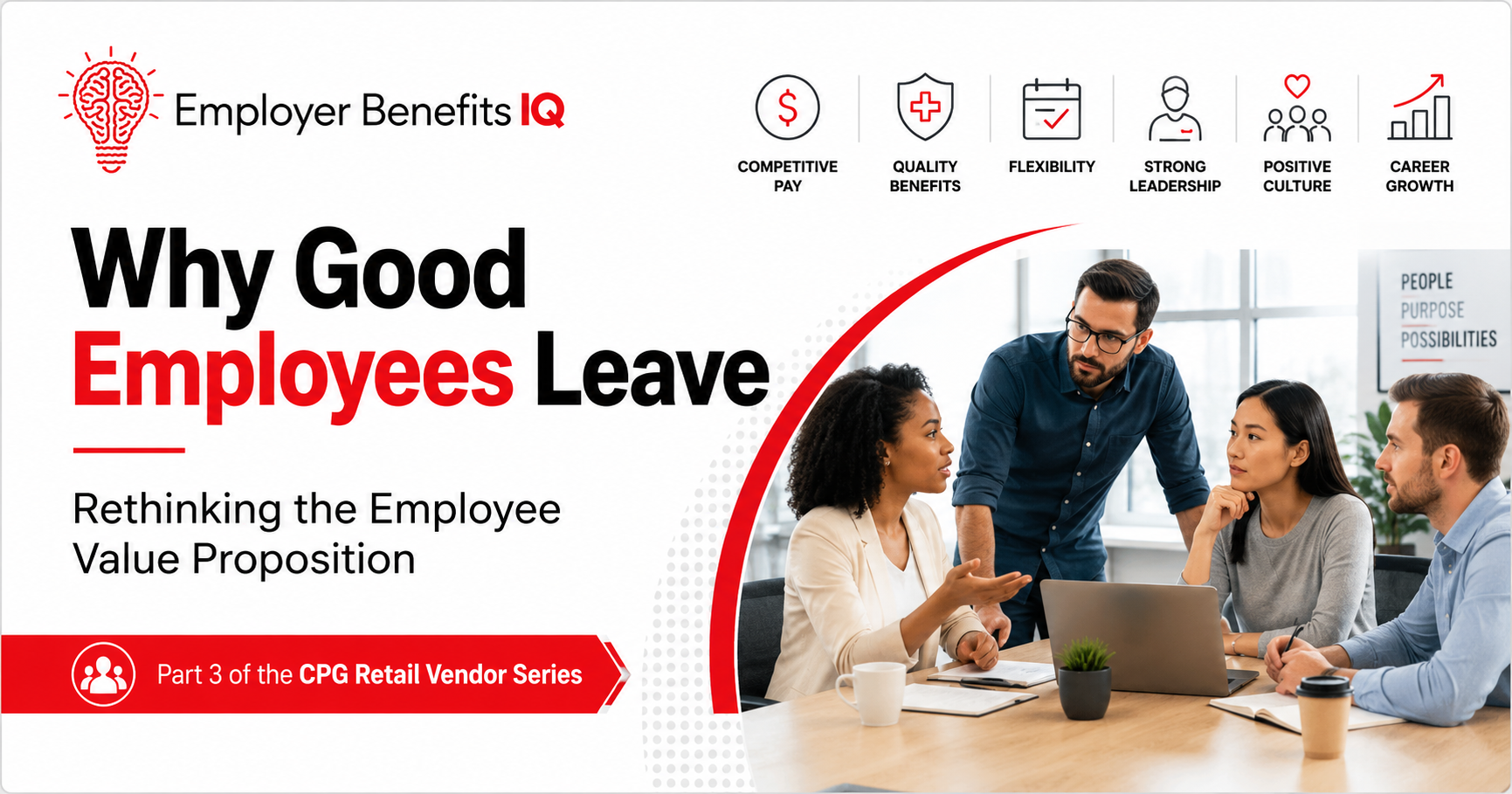
In Part 1 of this series, I wrote about the talent war in the Northwest Arkansas retail supplier community. In Part 2, I focused on healthcare affordability and why employee benefits should really be viewed as part of compensation. This article brings those two conversations together because, at the end of the day, the real question is pretty simple: why do good employees leave?
Most employers would probably prefer a simple answer. If compensation is too low, raise compensation. If the health plan is weak, improve it. If employees want more flexibility, offer more flexibility. The reality is rarely that clean. In my experience, people usually do not leave because of one bad day, one benefit, or one policy. They leave because over time, the overall value of staying starts to feel weaker than the value of going somewhere else.
That matters even more in Northwest Arkansas because good employees have options. A strong category manager, retail media specialist, analyst, sales executive, finance professional, replenishment leader, or e-commerce employee may not have to make some dramatic life change to leave your company. Another supplier, agency, technology firm, or retailer ten minutes away may be willing to hire them. In some cases, the next employer may not even be in Arkansas if the position can be done remotely.
That is why I think retail suppliers need to stop looking at retention as a collection of individual HR programs and start looking at the whole employment experience. Employees do not separate your company into departments the way leadership does. They do not think, “HR handles my benefits, finance handles my pay, my manager handles my workload, and leadership owns the culture.” They experience one employer, and all of those things get rolled together into one decision about whether working for you is still worth it.
The phrase “employee value proposition” gets used a lot, and sometimes it sounds more complicated than it really is. To me, it comes down to two questions: why should somebody work for you instead of somewhere else, and once they are here, why should they stay?
Salary is obviously part of the answer, but it is only part of it. Healthcare matters. Retirement matters. PTO matters. Flexibility matters. Career development matters. Leadership matters. Recognition matters. Culture matters. The relationship an employee has with their manager matters. The workload matters. Whether they can see a future inside the company matters.
If compensation is strong but the manager is miserable to work for, that matters. If the culture is good but family healthcare is unaffordable, that matters. If the benefits are competitive but an employee cannot see any opportunity to grow, that matters too. The entire package has to make sense because employees are evaluating all of it together.
One thing I think employers underestimate is how long someone may be mentally checking out before they officially resign. Most employees do not wake up on a Tuesday morning and suddenly decide they are done. It usually develops over time. Maybe they stop feeling challenged. Maybe they start wondering whether there is anywhere for them to go inside the company. Their workload increases, but compensation stays the same. Their manager becomes less engaged. Somebody else gets promoted. Healthcare gets more expensive again. Then a recruiter calls at exactly the right time.
Any one of those things may not be enough to make someone leave. Put enough of them together and the math changes. Then another employer makes the decision easier with a little more money, a hybrid schedule, better family healthcare, a bigger title, a shorter commute, or simply a clearer path forward.
By the time the resignation letter reaches HR, the employee may have been leaving emotionally for six months.
That is one of the reasons I do not think exit interviews are enough. They are useful, but the information arrives after the decision has already been made. I would rather know what is frustrating a high-performing employee while they are still sitting in the building than hear about it during their last week.
Compensation absolutely has to be part of this discussion. People work for money, and if a company is materially below market, there is going to be a problem sooner or later. That is especially true in Northwest Arkansas because people inside the supplier community tend to know what other companies are paying. Former coworkers stay in touch, recruiters are active, and employees move between suppliers. Information travels pretty quickly in a market like this.
At the same time, I do not think salary alone is a very good retention strategy. There will almost always be somebody willing to pay a strong employee more. If your entire defense against turnover is matching outside offers, eventually you are going to lose that game.
Counteroffers can work, but they do not always fix the reason the person was willing to leave in the first place. If the employee felt there was nowhere to go inside the organization, an extra $8,000 probably did not create a career path. If the problem was a bad manager, the raise did not fix the manager. If the person felt ignored, the counteroffer may actually reinforce the idea that the company only started paying attention once they threatened to walk out the door.
The better approach is making the overall relationship strong enough that another offer has to overcome more than salary.
Healthcare is a huge part of that, which is why I spent so much time on it in Part 2. Employers often look at healthcare as a budget issue, but employees experience it personally. One employee may barely use the plan all year. Another may have a child with a chronic condition, a spouse going through cancer treatment, several expensive medications, or ongoing mental health needs.
When the employer raises payroll contributions or increases the deductible, those employees do not experience it as a plan design adjustment. They experience it at their kitchen table.
That is why healthcare affordability carries more weight than I think a lot of employers realize. If another company offers similar pay but a much better family health plan, that difference may be worth thousands of dollars to the employee. What looks like a small difference on a benchmarking report may look very different to a family using the plan every month.
Flexibility has become part of the equation too. I still hear remote and hybrid work described as though it is mostly an employee preference, but for a lot of people it has real economic and lifestyle value. If someone can work from home two days a week, that may mean less commuting, less childcare expense, an easier school pickup, or the ability to handle an appointment without burning half a day of PTO.
That has value, even if it never appears on a paycheck.
I am not suggesting every supplier needs to become a remote company. There is real value in being close to Walmart and Sam’s Club, working with a team in person, and staying connected to the Northwest Arkansas business community. Employers just need to be realistic about the trade-off. If one company requires five days in the office and another offers meaningful flexibility, the employee is going to compare those two experiences. If you are asking someone to give up flexibility, something else about your opportunity has to be valuable enough to offset it.
Career development may be one of the biggest missed opportunities I see, especially with strong employees. The people you most want to keep are often the same people most likely to be recruited because they are ambitious, capable, and looking for what comes next.
Smaller suppliers sometimes struggle with this because they do not have twelve layers of management or a new title available every two years. That does not mean you cannot create growth. Career development can mean more responsibility, exposure to leadership, ownership of important projects, professional education, mentoring, cross-functional work, or a greater role in strategic decisions.
In fact, smaller companies can sometimes offer those things faster than much larger employers. A talented employee at a 100-person supplier may get to work directly with senior leadership, sit in important retailer meetings, own a major initiative, or influence decisions that might take years to reach inside a much bigger company.
That is a real advantage, but only if the employee can see it. Leadership can believe someone has a bright future inside the company, but if nobody has ever sat down and explained what that future could look like, the employee may assume it does not exist.
Managers are another big part of the retention conversation, and no benefits strategy can cover up poor management forever. A strong manager can make a hard job manageable. A bad manager can make an otherwise great job miserable. Employees want clarity, feedback, reasonable expectations, recognition, and confidence that problems will actually be addressed. Those things are not complicated, but they are hard to deliver consistently.
I have seen organizations spend a tremendous amount of money trying to improve the employee experience while ignoring the manager who is driving good people out the door. You can have an excellent health plan, generous PTO, a strong retirement contribution, and a great office, but if somebody dreads every interaction with their manager, those other things eventually lose value.
PTO is similar because the written policy and the actual culture are not always the same. A company may technically offer generous time off while creating an environment where nobody feels comfortable using it. Employees notice when leaders never take vacation, answer emails from the beach, or make comments about somebody being out of the office.
That is not really generous PTO.
The supplier business can make this particularly difficult because there is always something happening. There are retailer meetings, line reviews, resets, presentations, planning cycles, customer demands, and deadlines that all feel important. But if employees never get a chance to truly disconnect, burnout eventually shows up somewhere, and often it shows up in turnover.
Employees also want to know whether the company understands that they have a life outside of work. That does not mean employers have to solve every personal problem. It means recognizing that people have children, aging parents, health issues, financial stress, school schedules, family emergencies, and everything else that comes with being human.
Parental leave, mental health support, caregiving flexibility, disability coverage, or simply having leadership that treats adults like adults when life happens can make a bigger difference than employers sometimes realize. People remember how the company treated them when things were difficult, and coworkers notice too.
Recognition is another area where companies can improve without spending much money. One of the strange things about high performers is that they can become easy to overlook because they are reliable. The struggling employee gets attention because something needs to be fixed. The new employee gets attention because they need training. The difficult employee gets attention because there is always an issue.
The person quietly doing an excellent job every day may hear very little.
Then leadership is surprised when they leave.
People want to know that their work matters. They want their effort noticed and their contribution understood. Sometimes another employer gets someone’s attention simply because that employer says the things their current company should have been saying all along.
Benefits communication works the same way. I see companies spend hundreds of thousands or millions of dollars on benefits that employees barely understand. The company funds an HSA, but employees forget. There is telemedicine, but nobody knows how to access it. There is an EAP with mental health resources, but people do not remember it exists. There is disability coverage, care navigation, advocacy, or a lower-cost healthcare option, but employees have no idea how any of it works.
Then leadership wonders why employees do not appreciate the benefits package.
I do not think that is an employee problem. If the company is spending that much money, explaining the value should be part of the investment. Open enrollment once a year is not enough. Employees need education throughout the year, especially when the benefits are complicated.
A good benefits package that nobody understands has far less recruiting and retention value than it should.
The employee experience starts earlier than most companies think too. Retention really begins during recruiting and onboarding. Candidates notice whether the process is organized, whether people communicate, whether interviewers seem prepared, whether the company can clearly explain why the opportunity is attractive, and whether benefits are presented professionally.
Those early interactions send a signal about how the organization operates.
This is actually an area where smaller suppliers can compete very well. You may not have a huge recruiting department, but you can create a more personal experience. A candidate can meet senior leadership. The hiring manager can explain why the position matters. Benefits can be explained clearly. The company can make somebody feel wanted instead of processed.
That is something large organizations do not always do well.
I think smaller suppliers should lean into those advantages instead of constantly trying to look like bigger companies. You do not need to become a miniature version of Walmart. You need to be good at the things a large company may have a harder time delivering.
Give employees access to leadership. Move quickly when a decision needs to be made. Recognize strong performance. Give talented people meaningful responsibility. Create flexibility where it makes sense. Make benefits easier to understand. Provide real advocacy when an employee has a healthcare problem. Let people see how their work affects the business.
Those things can be incredibly valuable, and they do not necessarily require a massive HR budget.
One change I would encourage employers to make is spending more time asking why good employees stay instead of only asking why people leave. Exit interviews have their place, but stay interviews can tell you much more while you still have time to do something about it.
Ask your strongest people what they like about working there. Ask what frustrates them. Ask what would make their job better. Ask what might cause them to take another call from a recruiter. Ask whether they understand the benefits. Ask whether they see a future inside the company.
You may hear things you do not love hearing, but that is the point.
I would much rather find out that a strong category analyst is frustrated about career development while they are still working for me than find out during their last week.
Listening to employees does not mean giving everybody everything they ask for. Employers still have budgets, operational needs, customer expectations, and business realities. Not every request deserves a new policy or benefit.
The goal is figuring out which issues actually affect recruiting, retention, performance, and culture.
If family healthcare costs keep coming up, that deserves attention. If your strongest people consistently ask for more flexibility, that means something. If career development shows up repeatedly, leadership should probably listen. If three employees ask for a trendy voluntary benefit, that may not deserve the same priority.
The job is to separate what is interesting from what is actually important.
Turnover data needs to be looked at the same way. A company-wide turnover percentage can hide a lot. Losing 15% of the workforce may not be catastrophic if those positions are relatively easy to replace. Losing three experienced Walmart-facing employees can be a very different problem.
Look at where people are leaving, which managers they report to, how long they were with the company, what positions they held, and where they went. Patterns usually tell a story.
If one manager loses good people every year, that means something. If employees consistently leave after two years because they cannot see a path forward, that means something. If strong employees keep leaving for companies with better family healthcare or more flexibility, that means something too.
The goal is not zero turnover. That is probably unrealistic and may not even be healthy. The goal is avoiding the loss of the people you can least afford to lose for reasons you could have addressed.
There is a financial side to all of this that I think employers sometimes miss. Benefits are easy to measure because you can see the cost on a spreadsheet. Turnover is harder because the real expense is spread across the business.
There are recruiting costs, but there is also lost productivity, management time, training, institutional knowledge, customer relationships, and the burden placed on everybody who stays behind. In a Northwest Arkansas retail supplier organization, losing someone who really understands the Walmart account can be especially disruptive because there is a learning curve to this market that does not show up neatly on a P&L.
That means some retention investments may have a much better return than they appear to at first glance. A better health plan costs money. Improving parental leave costs money. A stronger retirement contribution costs money. Management development costs money.
Turnover costs money too.
The comparison should not be between spending money and doing nothing. It should be between the investment you are making and the value it creates for the business.
Every company already has an employee value proposition whether leadership has intentionally created one or not. Employees figure it out pretty quickly. Maybe you pay extremely well but expect long hours. Maybe compensation is average but flexibility is exceptional. Maybe your strongest advantage is career development. Maybe it is culture, benefits, leadership access, or the chance to take on meaningful responsibility early in a career.
There is no perfect model that works for every company. The important thing is understanding what yours actually is and whether employees see it the same way leadership does.
If leadership believes culture is the company's greatest strength while employees think communication is terrible, there is a gap. If leadership thinks the health plan is generous while employees think it is unaffordable, there is a gap. If leadership thinks career opportunities are obvious while employees cannot see them, there is a gap.
Closing those gaps is where retention gets better.
If I were sitting with the leadership team of a Northwest Arkansas retail supplier, I would probably end the conversation with one question:
Why should your best employee still work here three years from now?
Think about that employee three years into the future. What will they have learned? How will their career have grown? What will their compensation look like? What will their benefits look like? What kind of relationship will they have with leadership? What opportunities will they have with you that they could not get somewhere else?
If the answer is simply that you hope they like working there, that probably is not enough.
Good employees have choices. The companies that keep them are usually the companies that give them reasons to stay long before another employer gives them a reason to leave.
For Northwest Arkansas CPG companies and retail suppliers, that is what the employee value proposition really comes down to. It is not an HR slogan or a benefits brochure. It is the accumulation of hundreds of decisions employees experience over the course of the year, from compensation and healthcare to leadership, recognition, flexibility, career opportunity, PTO, culture, and communication.
No single one of those things guarantees retention, but together they determine whether somebody still believes working for your company is the best opportunity available to them.
That is the standard I think employers should be measuring.
Coming Next: Part 4 — The Small-Team Problem: Competing Like a Large Employer Without Becoming One
In Part 4 of the Northwest Arkansas CPG Retail Vendor Series, I am going to focus on a challenge I see constantly inside the supplier community: how does a 50-, 100-, or 200-person company provide a sophisticated benefits and employee experience without building a massive HR department?
I do not think the answer is adding more administration. I think it is building a better operating model around employee advocacy, benefits communication, technology, vendor management, outside expertise, compliance, and enrollment.
Smaller suppliers do not have to become giant companies to compete for talent. They just have to become much better at the things employees actually notice.
Questions about this topic? I'm available for consulting engagements across Northwest Arkansas and beyond.
About the Author
Corry Hull, REBC®, CSFS®
VP of Employee Benefits · BHC Insurance
Corry Hull, REBC® CSFS®, is VP of Employee Benefits at BHC Insurance and the founder of Employer Benefits IQ (www.employerbenefitsiq.com). He is a Certified Health Rosetta Advisor — one of fewer than 200 nationwide — and a multi-year presenter at United Benefit Advisors (UBA) national conferences. He specializes in self-funded health plan design, PBM contract strategy, stop-loss structuring, group medical captives, and ACA/ERISA compliance for mid-market employers. His work has been recognized by Health Rosetta (Rosie Award, 2026), UBA (Producer Peak Performer, 2025–2024), and BHC Insurance (Producer of the Year, 2021–2025). His employer-education content has been referenced in BenefitsPro and cited within the Health Rosetta advisor community. All consulting and brokerage compensation is fully disclosed.