
Part 3: Administrative Waste — How Complexity Drains Employer Health Plans
When employers talk about healthcare costs, most of the conversation centers around hospitals, prescription drugs, large claims, and chronic conditions.

VP of Employee Benefits · BHC Insurance · Independent Benefits Consultant
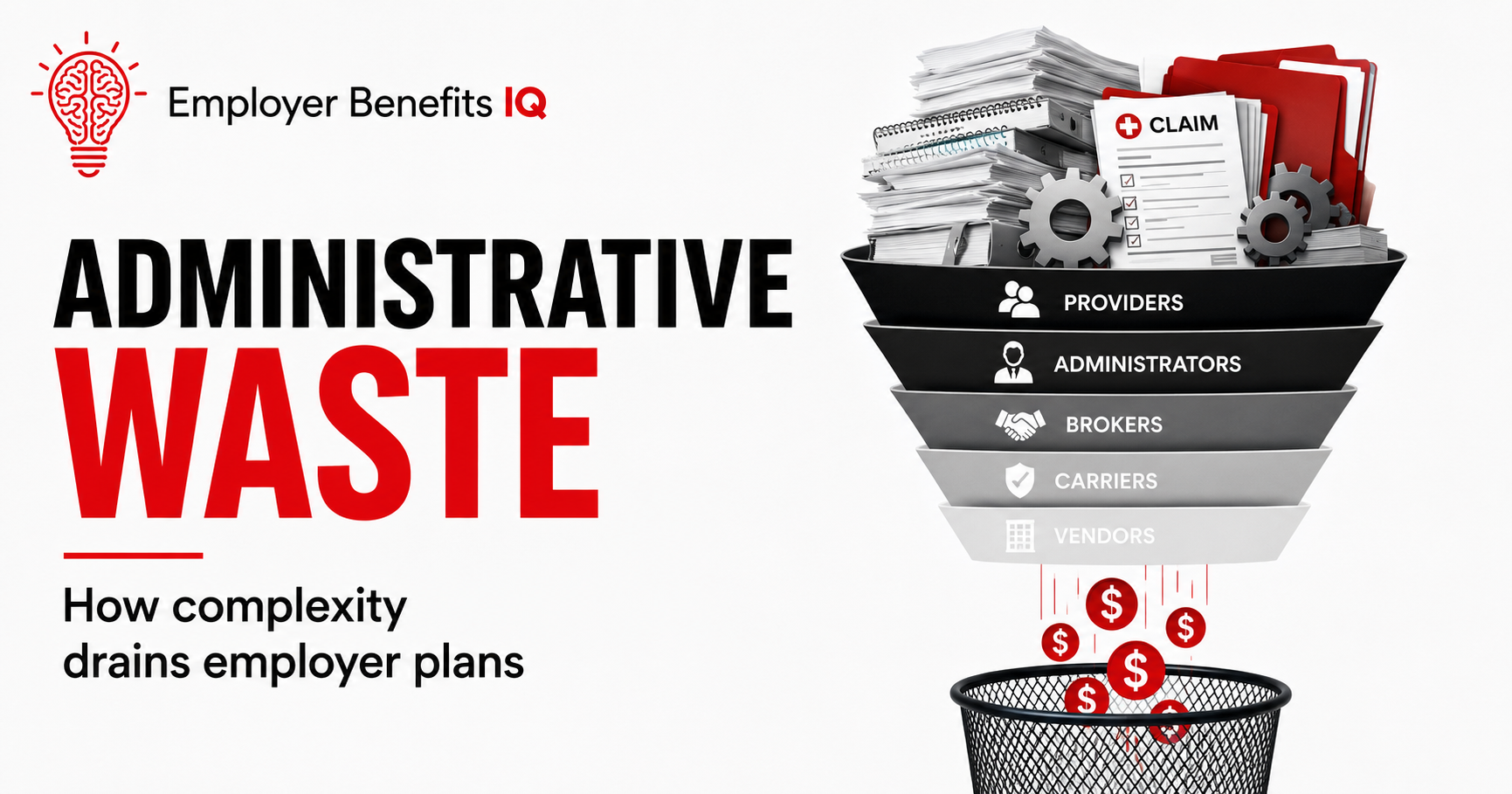
When employers talk about healthcare costs, most of the conversation centers around hospitals, prescription drugs, large claims, and chronic conditions. Those are major cost drivers, but another part of the system gets far less attention because it is harder to see: administration.
Healthcare has built an enormous infrastructure around delivering care. Claims have to be processed. Networks have to be managed. Providers have to be credentialed. Employees have to be enrolled. Prior authorizations have to be reviewed. Bills have to be coded. Eligibility has to be maintained. Pharmacy claims have to be adjudicated. Compliance has to be handled. Data has to be collected, cleaned, and reported. Vendors have to be coordinated.
A lot of that work is necessary. The problem is that we have created so many layers around healthcare that employers often pay for a complicated system without fully understanding what each layer costs or what value it is actually providing.
That is where I think the conversation needs to change.
If an employer spends $5 million a year on its health plan, how much of that money is actually paying doctors, hospitals, pharmacies, therapists, and other people delivering care? How much goes toward everything built around the care?
Most employers cannot answer that question very clearly.
They should be able to.
One of the strangest things about healthcare is how many organizations can touch the same healthcare dollar before it ever reaches the provider. An employer may have an insurance carrier, a TPA, a PPO network, a PBM, a specialty pharmacy, a stop-loss carrier, a broker or consultant, a navigation company, a utilization management vendor, a wellness platform, an enrollment vendor, a data analytics company, a compliance partner, and several condition-specific programs all operating inside the same plan.
Some of those organizations may be doing excellent work. I work with vendors all the time that create real value for employers and employees. The problem is not that vendors exist. The problem is that healthcare tends to solve complexity by adding more complexity.
If employees cannot figure out the health plan, we add navigation. If pharmacy costs are high, we add another pharmacy strategy. If musculoskeletal claims are high, we add an MSK vendor. If mental health becomes a concern, we add a mental health platform. If specialty drugs are expensive, we add another solution there.
Eventually, you can end up with a health plan that looks incredibly sophisticated on paper and feels completely overwhelming to the employee trying to use it.
At some point, employers have to step back and ask a simple question: Is the plan actually getting better, or are we just adding more to it?
That question matters because every layer has a cost.
A $ 3-per-employee-per-month fee does not sound like much. Neither does $5. Neither does a small percentage of claims. Neither does a network access fee, an administrative charge, a commission, or a percentage-of-savings arrangement.
But once you start stacking those fees across hundreds or thousands of employees, they add up quickly.
The bigger issue is that some compensation isn't always obvious. Some vendors charge a flat fee. Others are paid through commissions. Others make money through pharmacy margins, network arrangements, rebates, shared savings, or other contractual relationships.
There is nothing inherently wrong with any of that, but the employer should know how it works.
Whenever someone tells an employer that a healthcare solution is "free" or has "no cost," I think the next question should always be: **How do you make money?**
Someone is paying somewhere.
And in healthcare, that money usually comes back to the employer, the employee, the provider, or some combination of the three.
That doesn't mean companies shouldn't make a profit. Of course they should. It means the employer funding the plan should understand the economics.
Administrative waste also does not always come from bad actors or bad contracts. A lot of it is simply the natural result of a system that has become incredibly complicated.
Think about what happens when an employee gets care. The provider verifies insurance. A claim is created. Codes are assigned. The claim is sent to the payer. Network discounts are applied. The claim is adjudicated. The provider receives a remittance. The employee gets an explanation of benefits. Then the employee may receive a separate bill. If something is wrong, the provider appeals. The employee calls HR. HR calls the broker. The broker contacts the carrier or TPA. Someone reviews the claim. Eventually the issue gets corrected.
That is a lot of activity for one medical service.
Now multiply that process across thousands of claims.
Every step takes time, people, systems, technology, and money.
That is part of why healthcare can be so frustrating, even when the clinical care was excellent. A patient may spend 30 minutes with a doctor and then spend the next two months trying to understand the bill.
Employers pay for that complexity in ways that rarely show up neatly on a claims report.
HR teams spend hours fixing benefits problems. Employees spend time on the phone instead of working. Providers hire large billing departments. Carriers and TPAs hire people to process and review claims. Then employers hire advocacy or navigation companies to help employees work their way through the system.
Everybody is working very hard.
That does not mean the system is working efficiently.
I also think employers underestimate the cost of their own internal administration. Ask an HR team how much time they spend answering benefits questions, fixing enrollment problems, dealing with eligibility issues, chasing ID cards, resolving claims, communicating with vendors, explaining deductibles, helping employees understand bills, and handling issues that should probably be solved somewhere else.
That time has a real cost.
If highly compensated HR professionals are spending several hours every week acting as the customer service department for an insurance carrier, TPA, or vendor, the employer is absorbing an administrative expense that will never appear on the renewal.
The same thing applies to employees. If someone spends two hours on the phone trying to resolve a claim, that is not just an inconvenience. It carries a productivity cost.
Multiply that across hundreds of employees and poor administration becomes a business problem.
That is why I think service needs to be viewed as a financial issue, not just a benefits issue.
Poor service is expensive.
Another thing employers need to watch is the explosion of point solutions in healthcare. There are companies for diabetes, musculoskeletal care, mental health, cancer, fertility, virtual primary care, surgery, imaging, second opinions, specialty drugs, navigation, advocacy, and just about anything else you can think of.
Some of these solutions are very good.
But more vendors do not automatically mean a better health plan.
One company manages diabetes. Another handles MSK. Another handles mental health. Another handles navigation. Another has telemedicine. Another handles pharmacy. Another has a Centers of Excellence program.
Each one may make sense on its own.
But what does that experience look like to the employee?
Do they know which program to use? Do the vendors communicate with each other? Does the data move between them? Is there one place for the employee to start, or are we giving them eight phone numbers, nine websites, and a dozen apps?
A benefits program can look outstanding in a PowerPoint presentation and still be almost impossible to use in real life.
If employees don't know a solution exists or don't understand how to use it, the employer isn't really buying a solution.
It is buying another invoice.
We often hear that employees have an engagement problem. Sometimes they do. But sometimes the benefits program itself is the problem.
Think about everything we ask an employee to understand: deductibles, coinsurance, copays, networks, formularies, prior authorization, HSAs, FSAs, telemedicine, urgent care, emergency rooms, specialty pharmacy, navigation, wellness programs, Centers of Excellence, mental health programs, voluntary benefits, and everything else.
Then we hand them a large enrollment guide once a year and wonder why they are confused.
Most employees do not want to become benefits experts. They want to know where to go when they need help.
That is why I believe a good health plan should make the right decision easier than the wrong one.
If an employer has a better imaging option, employees shouldn't have to search through three apps to find it. If a higher-quality surgical program costs the employee less, the plan should make that option easy to access. If there is an advocacy team, employees should know exactly who to call.
Good benefits administration should reduce friction.
Too often, we add programs and accidentally create more of it.
Claims administration deserves the same scrutiny.
For a self-funded employer in particular, the TPA or carrier may be processing millions of dollars in claims every year. That means employers should be asking questions about how claims are adjudicated, what edits are applied before payment, how duplicate claims are handled, how high-dollar claims are reviewed, how out-of-network claims are priced, how quickly claims are processed, what reporting is available, and how errors are corrected.
That is not just customer service.
That is financial administration.
If another vendor inside the organization was responsible for paying millions of dollars on the company's behalf, leadership would want to understand exactly how those payments were being handled.
Healthcare should be no different.
The same applies to percentage-of-savings arrangements.
These models can work well, but employers should understand how the savings are calculated.
Savings compared to what?
The billed charge? The network allowed amount? A Medicare benchmark? Some other baseline?
If a provider submits a $100,000 bill and a vendor reduces it to $50,000, the vendor may report a $50,000 savings. Maybe that is legitimate.
But if the reasonable market price was $35,000, then the employer may still be overpaying.
The headline savings number is not always the number that matters most.
What matters is what the plan actually spent.
Technology is another area where I think we need to be careful. Healthcare technology has improved tremendously. Employers have better analytics, navigation tools, price transparency, reporting, and mobile access than they did years ago.
But technology only helps if it makes the experience simpler.
If employees have one portal for the carrier, another for pharmacy, another for the HSA, another for telemedicine, another for mental health, another for wellness, another for navigation, and another for voluntary benefits, we have not really simplified much.
We just moved the complexity onto a screen.
Technology should remove friction, not create another login.
This is why I believe employers need to stop thinking about their benefits program as a collection of products and start thinking about the health plan as one coordinated system.
Every vendor should have a purpose.
Every contract should have a reason.
Every fee should be understood.
Every program should solve a real problem.
And the employee should have a clear path into the system when they need help.
That does not mean employers should automatically reduce the number of vendors. In some cases, multiple specialized partners are exactly what the plan needs.
The key is coordination.
Do the vendors know their roles? Do the incentives line up? Can they share data? Is someone managing the entire ecosystem? Can the employer actually measure whether these programs are working?
Those are the questions that matter.
I also think employers need to get much better at measuring value instead of activity.
Healthcare vendors are very good at showing activity. Number of calls. Number of app downloads. Number of registrations. Number of coaching sessions. Number of cases opened.
Those numbers are fine, but they are not necessarily outcomes.
Did the program reduce cost? Did employees get better care? Did the program move people to better providers? Did it reduce avoidable utilization? Did it save HR time? Did employees actually use the service when they needed it?
That is the kind of value employers should be looking for.
One of the best exercises an employer can do is put every organization touching the health plan on one page.
The carrier. The TPA. The network. The PBM. The broker. Stop-loss. Navigation. Compliance. Enrollment. Analytics. Specialty vendors. Condition management programs. Everyone.
Then ask a few simple questions.
What problem does this company solve? How are they paid? What are we actually paying them? What results are they producing? What data do they receive? Who manages the relationship? Do employees understand how to use the service? Is another vendor already providing something similar?
That exercise can be eye-opening.
You may find overlapping services you are paying for twice. You may find programs nobody uses. You may find contracts that have not been reviewed in years. You may also discover gaps where the employer truly needs more support.
The goal is not to eliminate vendors.
The goal is to understand the plan.
Complexity has become a cost driver in itself.
Someone has to manage all of these moving pieces. Someone has to reconcile the data. Someone has to fix the claim. Someone has to answer the employee's question. Someone has to manage the vendors.
Every additional layer adds another opportunity for cost, confusion, and waste.
The best health plans I see are not always the ones with the most programs.
They are the ones where the pieces actually work together.
Employees know where to go. HR knows who to call. Data is available. Contracts are understood. Vendors are accountable. And somebody is looking at the entire plan instead of managing each piece in isolation.
If I were responsible for an employer health plan, I would want someone to show me every administrative layer between the employer and the actual delivery of care.
What are we paying for each layer, how are these organizations compensated, and what value are we receiving in return?
I would also want to know where services overlap, where employees are getting confused, where HR is spending time it shouldn't be, and which vendors are actually producing measurable results.
Administrative waste rarely shows up as one huge claim.
It hides in duplicated services, unnecessary fees, confusing processes, poorly coordinated vendors, inefficient contracts, and thousands of hours of wasted time.
That makes it easy to overlook.
It does not make it inexpensive.
Employers spend too much money on healthcare to let complexity become an excuse for not understanding how the system works.
The goal is not to build the most complicated health plan.
The goal is to build one that actually works.
In Part 4 of **The Employer Healthcare Cost Crisis: Where Is All the Money Going?**, I am going to turn to one of the biggest long-term drivers of employer healthcare spending: chronic conditions.
Diabetes, obesity, cardiovascular disease, musculoskeletal conditions, cancer, and behavioral health are not just isolated claims. They shape a health plan's financial trajectory for years.
Before we get there, I would like to hear what others are seeing.
Has your benefits program become too complicated? Are employees overwhelmed by too many programs? Are you paying multiple vendors for overlapping services? How much time is your HR team spending fixing problems that should be handled somewhere else?
Leave a comment or send me a question.
Sometimes the biggest opportunity in an employer health plan is not adding another solution.
It is finally understanding everything you are already paying for.
Questions about this topic? I'm available for consulting engagements across Northwest Arkansas and beyond.
About the Author
Corry Hull, REBC®, CSFS®
VP of Employee Benefits · BHC Insurance
Corry Hull, REBC® CSFS®, is VP of Employee Benefits at BHC Insurance and the founder of Employer Benefits IQ (www.employerbenefitsiq.com). He is a Certified Health Rosetta Advisor — one of fewer than 200 nationwide — and a multi-year presenter at United Benefit Advisors (UBA) national conferences. He specializes in self-funded health plan design, PBM contract strategy, stop-loss structuring, group medical captives, and ACA/ERISA compliance for mid-market employers. His work has been recognized by Health Rosetta (Rosie Award, 2026), UBA (Producer Peak Performer, 2025–2024), and BHC Insurance (Producer of the Year, 2021–2025). His employer-education content has been referenced in BenefitsPro and cited within the Health Rosetta advisor community. All consulting and brokerage compensation is fully disclosed.