
Part 2 — Benefits Are Compensation: The Healthcare Affordability Problem Facing Northwest Arkansas Retail Suppliers
In Part 1 of this series, I wrote about the competition for talent inside the Northwest Arkansas retail supplier community and why I think many companies are benchmarking themselve…

VP of Employee Benefits · BHC Insurance · Independent Benefits Consultant
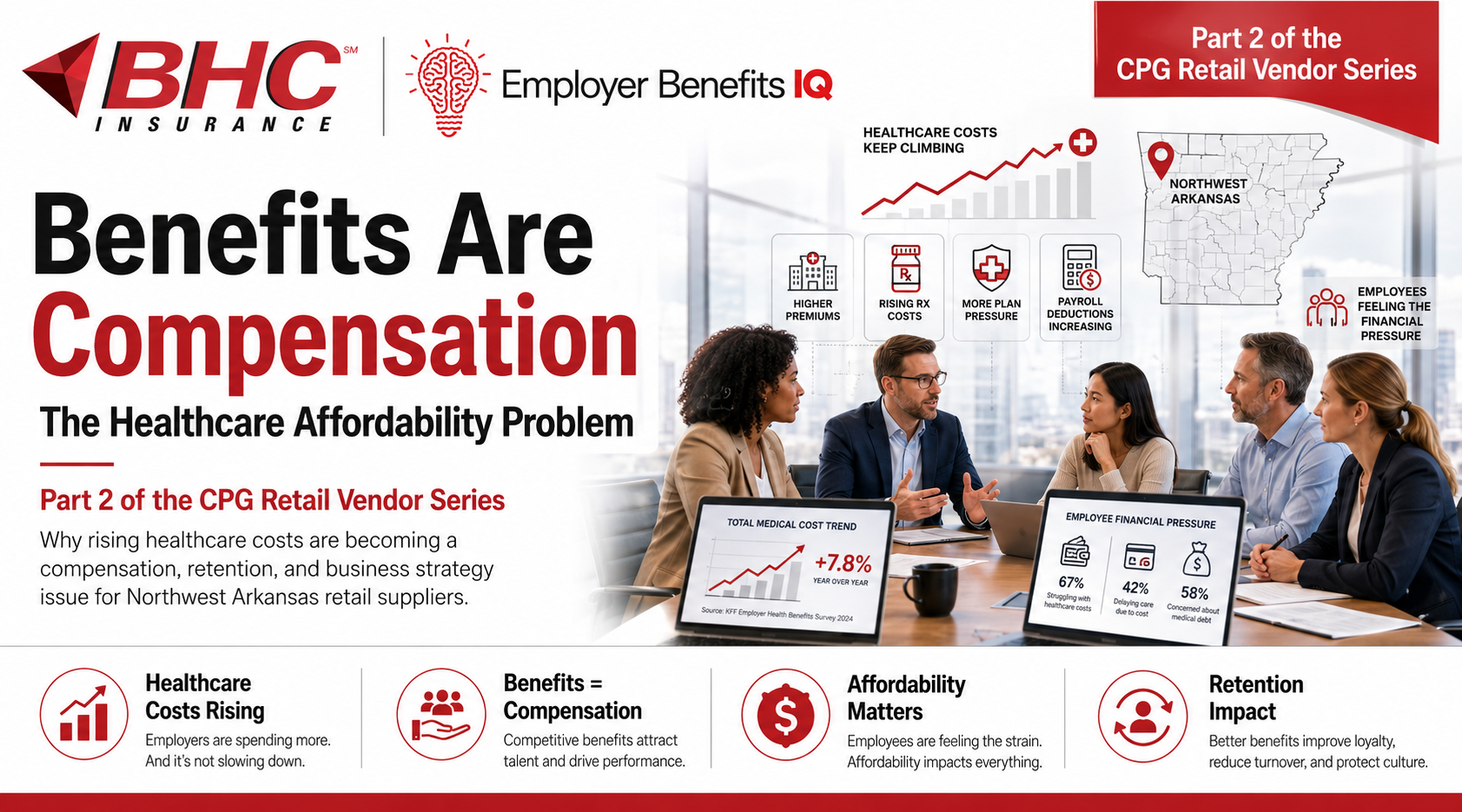
In Part 1 of this series, I wrote about the competition for talent inside the Northwest Arkansas retail supplier community and why I think many companies are benchmarking themselves against the wrong competitors. A CPG supplier in Bentonville, Rogers, Lowell, or Springdale may be competing for employees with another supplier, Walmart, an agency, a technology company, a data firm, or an employer located hundreds of miles away that is willing to let someone work remotely.
That makes compensation important, but compensation is bigger than salary.
I think that is where the employee benefits conversation needs to change.
When a company spends $15,000, $18,000, or $20,000 per employee on healthcare, that money is part of what it costs to employ that person. It may not show up on the employee's paycheck, but it is absolutely part of the employer's total compensation investment. The problem is that employees do not always experience it that way.
An employer may look at the benefits budget and think, "We are spending a fortune on healthcare." An employee can look at the exact same health plan and think, "My insurance is expensive."
Both can be right.
That disconnect is becoming one of the biggest problems in employee benefits, and I think it matters even more in a competitive talent market like Northwest Arkansas.
Employers Are Spending More, but Employees Don't Necessarily Feel Better Off
Healthcare costs are moving in the wrong direction again. Aon is projecting employer healthcare costs to increase another 9.5% in 2027 before employers make changes to mitigate the increase. Mercer expects average employer health benefit costs to exceed $18,500 per employee in 2026, with prescription drug spending among the fastest-growing parts of the healthcare budget.
KFF reported that the average annual premium for employer-sponsored family coverage reached nearly $27,000 in 2025. Employees contributed an average of $6,850 of that amount through payroll deductions, while employers paid the balance.
Those are big numbers, but I think the practical impact becomes clearer when you bring it down to the company level.
Imagine a Northwest Arkansas retail supplier with 200 employees. Depending on enrollment, demographics, plan design, and funding arrangement, that company may be spending several million dollars a year on healthcare.
If any other expense on the P&L approached that level and increased 8%, 10%, or 15% year after year, leadership would want to understand every piece of it.
If freight costs jumped, somebody would dig into the freight strategy. If raw materials increased dramatically, purchasing would be involved. If a major vendor raised its fees 15%, there would probably be a difficult conversation about whether that relationship still made sense.
Healthcare is often treated differently.
The renewal arrives, everybody looks at the percentage increase, the broker negotiates with the carrier, a few alternative plans are reviewed, and then the conversation turns to how much of the increase the company can absorb and how much needs to be passed along to employees.
That may be necessary in the short term, but I would not call it a healthcare strategy.
It is really a conversation about who is going to pay the increase.
Cost Shifting Eventually Becomes a Compensation Cut
There are only so many places an employer can move healthcare costs.
You can increase payroll deductions. You can increase deductibles. You can raise the out-of-pocket maximum. You can move employees toward higher-deductible health plans. You can increase copays or coinsurance.
All of those tools have a place, and sometimes they are absolutely appropriate. The problem is what happens when they become the primary strategy year after year.
At some point, cost shifting stops feeling like benefits management and starts feeling like a reduction in compensation.
Consider an employee who receives a 4% salary increase. On paper, the company gave that person a meaningful raise. But if the employee's family medical contribution increases by $125 a month, that is $1,500 a year coming right back out of the paycheck. If the deductible increases at the same time, the employee may have even more financial exposure when somebody in the family actually needs care.
The employer sees a raise.
The employee may feel like they are standing still.
That matters when another employer comes calling.
Healthcare affordability does not exist in its own little benefits bubble. It affects how employees perceive compensation, how much financial stress they carry, whether they delay care, and ultimately how they evaluate another job opportunity.
Mercer recently reported that nearly half of large U.S. employers expect to make medical plan changes for 2027 that will result in higher out-of-pocket costs for employees. At the same time, employers are also looking for alternative strategies because they know there is a limit to how much more cost employees can realistically absorb.
I think that limit is becoming one of the most important issues employers are going to have to deal with over the next several years.
The Cheapest Health Plan Isn't Necessarily the Best Financial Decision
There is a natural tendency to approach employee benefits like any other procurement exercise and try to get the lowest possible price.
I understand that.
The problem is that healthcare is different because the product is being consumed by the people you are trying to recruit and retain.
A cheaper plan that creates a significantly worse employee experience may save money in one column while creating costs somewhere else.
If employees cannot afford to use the plan, they may delay care. If they cannot find a primary care physician, conditions may go unmanaged. If a high deductible discourages someone from getting an MRI or seeing a specialist, a manageable issue today can become an expensive problem later.
Then there is the retention side of the equation.
If your strongest employees can go to another company and pay less for family coverage, receive a lower deductible, get a better employer HSA contribution, or simply have an easier healthcare experience, that difference becomes part of their compensation decision.
That does not mean every employer should offer the richest health plan possible. Most companies simply cannot afford to do that.
It means the objective should not be to buy the cheapest insurance.
The objective should be to get the highest value from the dollars the company and employees are already spending.
Those are very different goals.
Before You Cut Benefits, Understand What Is Driving the Cost
One of the things I encourage employers to do is slow down before assuming the health plan itself is the problem.
A 15% increase does not automatically mean employees used 15% more healthcare.
There may be a few large claims driving the increase. It may be specialty pharmacy. It may be GLP-1 utilization. It may be hospital pricing. It may be cancer treatment, dialysis, infusion therapy, specialty drugs, or a handful of complex chronic conditions.
It could also be the underlying contracts.
For fully insured employers, there may be less visibility into some of these details, but that does not mean leadership should simply accept the renewal as a black box.
For self-funded employers, there is even less excuse not to understand the underlying data.
You should know what is driving the plan.
How much is medical versus pharmacy? Where are the highest-cost claims occurring? Which hospitals and health systems are being used? Are employees receiving outpatient services in high-cost hospital settings that could have been delivered somewhere else? How much is being spent on specialty medications? What is the PBM actually earning? What rebates and other compensation are flowing through the pharmacy contract?
Those questions are not designed to make HR become a healthcare economist.
They are designed to make the employer behave like a responsible purchaser.
If you are spending millions of dollars, you should have some idea what you are buying.
Pharmacy Is Becoming Too Big to Treat Like a Side Issue
For years, employers could spend most of their benefits strategy meeting talking about the medical plan and then spend ten minutes discussing prescription drugs.
I do not think that works anymore.
Mercer reported that prescription drug benefit costs were expected to rise around 9% in 2026, driven in part by specialty drugs and growing GLP-1 utilization. Employers are responding by taking a much harder look at their PBMs, contracting structures, transparency, and utilization management.
That is exactly what should be happening.
For many employers, the pharmacy benefit is now one of the fastest-growing expenses in the entire health plan. Specialty medications can cost tens or hundreds of thousands of dollars per patient per year. GLP-1 medications have created an entirely new affordability conversation. Gene and cell therapies can push individual claims into the millions.
That does not mean employers should simply stop covering expensive medications. Many of these treatments can be life-changing.
It does mean employers need to know what they are paying and why.
The traditional PBM model has become incredibly complicated. Rebates, spread pricing, specialty pharmacy margins, administrative fees, manufacturer revenue, group purchasing organizations, and various guarantees can make it difficult for an employer to know whether the contract is actually delivering value.
If the pharmacy program represents a significant percentage of healthcare spending, it deserves significant oversight.
Where Care Happens Matters More Than Most Employees Realize
Healthcare has another strange characteristic that would be difficult to tolerate in almost any other industry: the same service can have dramatically different prices depending on where it is delivered.
An MRI can cost one amount at a hospital outpatient department and a fraction of that amount at an independent imaging center. An infusion can be substantially more expensive in a hospital than in a lower-cost outpatient setting. Some surgeries can be performed safely at an ambulatory surgery center rather than a hospital.
The employee frequently has no idea there is a difference.
They are simply told where to go.
This is where healthcare affordability and employee engagement start to intersect.
For years, employers have told employees to "be better healthcare consumers," but then we give them a system where prices are difficult to understand, quality is hard to compare, and the person referring them for care may have no financial incentive to consider the cost.
That is asking a lot of the employee.
If employers want employees to use healthcare differently, the health plan needs to make the better choice easier.
That may mean care navigation, advocacy, centers of excellence, direct contracts, high-performance networks, second-opinion programs, independent imaging, site-of-care strategies, or incentives that actually reward employees for making a higher-value decision.
Simply sending another email telling people to shop around is probably not going to solve the problem.
Better Healthcare Can Sometimes Cost Less
One of the misconceptions I see is the assumption that controlling healthcare costs always means reducing benefits.
It does not.
Some of the most effective cost-management strategies can actually improve the employee experience.
A direct primary care arrangement may provide employees with easier access to a physician while reducing unnecessary emergency room and urgent care utilization.
A well-designed navigation program can help an employee find the right provider instead of leaving them to figure everything out on their own.
A centers-of-excellence program can steer someone toward a provider that performs a procedure more frequently, has better outcomes, and may cost less.
An independent imaging strategy may reduce the employee's out-of-pocket cost while saving the plan money at the same time.
A better pharmacy contract can lower plan spending without changing the medication an employee receives.
That is the kind of healthcare cost management I think employers should be looking for.
Find the places where the employer and the employee can win at the same time.
There are more of those opportunities than many companies realize.
The Benefits Strategy Should Reflect the People You Are Trying to Keep
Healthcare affordability also looks different depending on the employee.
A young single employee earning $80,000 may look at a $3,000 deductible very differently from an employee earning $50,000 with a spouse and two children.
A family dealing with diabetes, cancer, multiple prescriptions, or ongoing behavioral healthcare sees the plan differently from someone who goes to the doctor once a year.
That is why looking only at the employee-only premium contribution can be misleading.
What does family coverage cost?
What does the deductible look like?
How much financial exposure does an employee have before the plan begins paying meaningfully?
What happens if someone needs a specialty medication?
Can employees afford the care the plan technically covers?
There is a big difference between having health insurance and having affordable access to healthcare.
Employers competing for talent need to understand that distinction.
Smaller Employers May Have More Options Than They Think
One of the frustrations I hear from smaller and middle-market companies is that they feel like they do not have enough employees to influence healthcare costs.
There is some truth to that. A 100-person company does not have the purchasing leverage of Walmart.
But that does not mean the only option is accepting whatever renewal arrives every year.
There are more funding and purchasing strategies available to middle-market employers than there were even a few years ago.
Depending on the company, that may include level funding, self-funding, group captives, alternative networks, transparent PBMs, direct primary care, reference-based pricing, centers of excellence, care navigation, specialty pharmacy strategies, and other targeted cost-containment solutions.
Not every strategy is right for every employer.
That is important.
I am not a believer in forcing every company into self-funding or putting every employer into a captive because those happen to be the strategies getting attention right now. The right solution depends on company size, risk tolerance, demographics, cash flow, claims experience, leadership philosophy, and how much control the employer actually wants.
What matters is understanding the options.
If a company has been fully insured with the same carrier for ten years and the only annual decision is whether to accept Plan A, B, or C, I think it is fair to ask whether the market has changed faster than the benefits strategy has.
Benefits Communication Is Part of the Value
There is another piece of this that employers sometimes overlook.
You can build a great health plan and still get very little retention value from it if employees do not understand what they have.
If the company pays 80% of the premium, does the employee know what that actually represents in dollars?
If you fund an HSA, do employees understand the value?
If you provide free telemedicine, second opinions, mental health resources, navigation, or lower-cost care options, do people know how to use them?
Benefits are one of the few parts of compensation where an employer can spend thousands of dollars per person and the employee may have very little idea what the company is actually providing.
That is not an employee problem.
That is a communication problem.
For Northwest Arkansas retail suppliers competing against companies with much bigger HR departments, communication can be one of the easiest areas to improve. You may not be able to outspend a Fortune 50 company, but you can make sure employees understand what you provide, why it matters, and how to use it.
Sometimes perceived value is improved without adding another dollar of benefits spending.
The Conversation Leadership Should Be Having
When healthcare costs rise, I think the conversation between HR, finance, ownership, and leadership needs to be broader than, "How much did the renewal go up?"
A better conversation starts with understanding the economics of the health plan.
What are we spending per employee? What is driving the increase? How much are employees paying? Which part of the plan is growing fastest? Where are we paying significantly more than we should? What risks are emerging over the next three years?
Then the conversation needs to move to the workforce.
Which employees are we trying hardest to recruit and retain? What does healthcare affordability look like for them? How do our employee contributions compare with the employers competing for our people? Are we making healthcare harder to use in an effort to make it cheaper?
Finally, leadership should ask whether the benefits strategy is aligned with the business strategy.
If the company says people are its biggest asset but every healthcare increase is solved by shifting more expense to those people, eventually there is a disconnect.
Sometimes the company needs to spend more.
Sometimes employees need to contribute more.
But there should be a strategy behind those decisions.
Turn Healthcare From an Expense Into an Advantage
I do not believe healthcare is going to suddenly become cheap.
The forces driving employer health plan costs are too significant. Hospital consolidation, prescription drug costs, specialty therapies, new technology, higher utilization, an aging workforce, chronic disease, and provider pricing are not going away.
Waiting for the healthcare system to fix itself probably is not a great strategy.
The opportunity for employers is to become better purchasers of healthcare.
Understand the data. Understand the contracts. Understand what employees value. Challenge the parts of the system that do not make sense, and stop assuming that higher cost automatically means better care.
For Northwest Arkansas retail suppliers, I think this creates an opportunity.
The companies that can provide employees with healthcare that is easier to understand, easier to access, and more financially manageable can turn what is normally viewed as a painful expense into a competitive advantage.
That does not mean spending unlimited money.
It means spending intentionally.
Because benefits are compensation whether employers treat them that way or not.
If you are spending $18,000 or $20,000 per employee on healthcare, that money should be doing more than paying claims. It should be helping your employees access good care, protecting their families financially, and strengthening the overall value of working for your company.
If it is not doing those things, the answer probably is not simply paying the next renewal.
It is asking better questions about where the money is going.
Coming Next: Part 3 — Why Good Employees Leave: Rethinking the Employee Value Proposition
In Part 3 of the Northwest Arkansas CPG Retail Vendor Series, I am going to broaden the conversation beyond health insurance.
Healthcare is important, but employees do not stay or leave because of one benefit. They evaluate the entire experience: compensation, flexibility, PTO, career development, leadership, recognition, culture, retirement, mental health support, and whether they believe there is a future for them inside the company.
For Northwest Arkansas retail suppliers, the real opportunity may not be offering more benefits.
It may be figuring out which benefits and workplace decisions actually matter to the people you cannot afford to lose.
Questions about this topic? I'm available for consulting engagements across Northwest Arkansas and beyond.
Sources & Further Reading
- KFF Employer Health Benefits Survey 2024 — Annual benchmark for employer premium costs, employee contributions, and cost-sharing trends across firm sizes.
- KFF: Average Annual Premiums for Employer-Sponsored Coverage, 2024 — Single and family premium averages used to contextualize affordability burden on employees.
- EBRI: Workers' Views on Health Care Costs and Coverage (2024) — Employee survey data on cost concerns, coverage satisfaction, and the relationship between benefits and job decisions.
- Bureau of Labor Statistics: Employer Costs for Employee Compensation — Health insurance as a share of total compensation — supports the "benefits are compensation" framing.
- Health Affairs: Cost Shifting to Workers Has Limits — Research on the relationship between employee cost-sharing increases and workforce outcomes including turnover.
- PCORI: Site of Care and Cost Variation in Outpatient Services — Documents cost variation by care setting — supports the "where care happens matters" section.
About the Author
Corry Hull, REBC®, CSFS®
VP of Employee Benefits · BHC Insurance
Corry Hull, REBC® CSFS®, is VP of Employee Benefits at BHC Insurance and the founder of Employer Benefits IQ (www.employerbenefitsiq.com). He is a Certified Health Rosetta Advisor — one of fewer than 200 nationwide — and a multi-year presenter at United Benefit Advisors (UBA) national conferences. He specializes in self-funded health plan design, PBM contract strategy, stop-loss structuring, group medical captives, and ACA/ERISA compliance for mid-market employers. His work has been recognized by Health Rosetta (Rosie Award, 2026), UBA (Producer Peak Performer, 2025–2024), and BHC Insurance (Producer of the Year, 2021–2025). His employer-education content has been referenced in BenefitsPro and cited within the Health Rosetta advisor community. All consulting and brokerage compensation is fully disclosed.