
Part 1 — The Northwest Arkansas Talent War: Who Are You Really Competing Against?
If you work for a CPG company or retail supplier in Northwest Arkansas, competition is part of the job.

VP of Employee Benefits · BHC Insurance · Independent Benefits Consultant
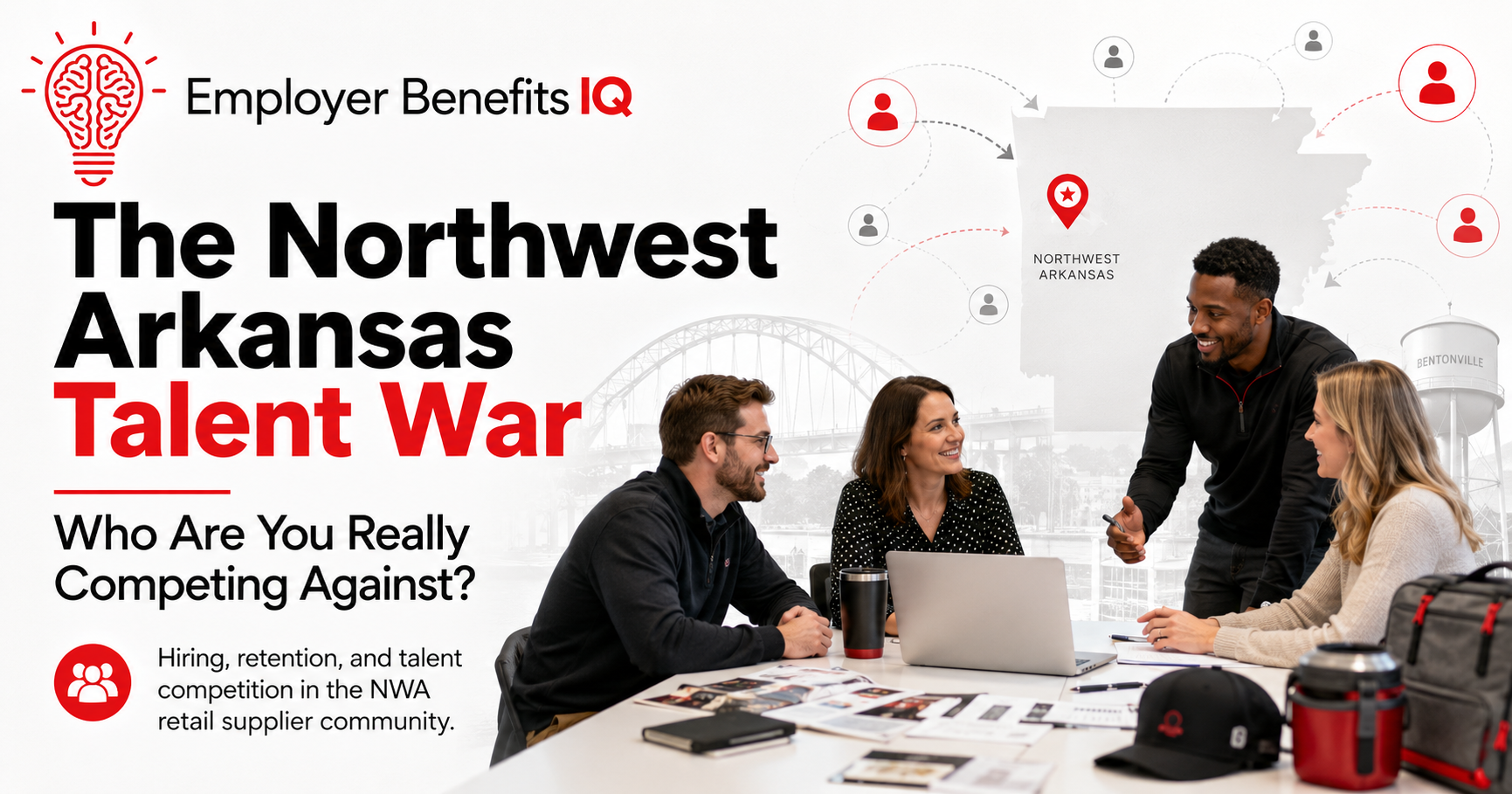
If you work for a CPG company or retail supplier in Northwest Arkansas, competition is part of the job. You know who you are fighting for shelf space, category growth, retail media dollars, pricing leverage, better placement, and stronger relationships with Walmart and Sam’s Club. Most companies spend a tremendous amount of time understanding that competitive landscape because it directly affects sales and growth.
What I think gets much less attention is the competition for people.
For a lot of Northwest Arkansas retail suppliers, the companies competing for your employees may not look anything like the companies competing with your products. Your talent competitors can be another supplier, Walmart, an agency, a technology company, a data and analytics firm, a logistics company, a startup, or even an employer located in another state that is perfectly comfortable letting someone work remotely from Bentonville or Rogers.
That is what makes the Northwest Arkansas talent market so unique. Few places in the country let someone build a career around a single retailer and still have this many potential employers competing for that experience. A good category analyst can leave one supplier and join another without changing industries or moving their family. The same is true for people in sales, shopper marketing, replenishment, supply chain, retail media, finance, e-commerce, analytics, and increasingly technology and AI.
In many cases, employees don't even have to change much about their lives. They may still work with the same retailer, interact with many of the same people, attend the same industry events, and drive to an office just a few miles away. That makes employee mobility much easier than in many other markets, and I think that changes the retention conversation in a pretty significant way.
When changing jobs comes with very little friction, good people have more options. In other markets, someone may have to relocate, change industries, build an entirely new network, or make a major lifestyle decision just to switch employers. Here, an experienced Walmart supplier employee can often take the knowledge and relationships they have developed over years and make them immediately valuable somewhere else in Northwest Arkansas.
That makes experienced talent incredibly valuable, but it also makes that talent very visible. Recruiters know who the good people are. Other suppliers know who they are. Former coworkers know who they are. In many cases, Walmart buyers and merchants know them too. When someone earns a reputation for understanding the retailer, managing a category well, running a complicated account, or navigating the Walmart ecosystem, it is probably not a secret.
That is why I think retention inside the Northwest Arkansas retail supplier community needs to be treated as more than an HR metric. For some positions, losing the right person can become a business continuity issue. When an experienced employee leaves, you do not just lose a name on an organizational chart. You lose institutional knowledge, relationships, productivity, and momentum. Other employees have to pick up the work, managers spend time recruiting and interviewing, and whoever you hire next still has to learn your organization, your customer, your systems, and all of the unwritten details that come with doing business in this market.
There is also one competitor in this conversation that is impossible to ignore, and that is Walmart.
This is where I think traditional benefits benchmarking can become a little misleading. A 100-person supplier may naturally compare its health plan, retirement benefits, PTO, and employer contributions to other companies with around 100 employees. From an insurance and benchmarking standpoint, that makes sense. From an employee's perspective, however, that may not be the comparison that matters.
If one of your employees receives an offer from Walmart, they are not going to dismiss it because Walmart has too many employees to be considered a fair benchmark. They are going to compare the jobs. They are going to look at compensation, healthcare, retirement, paid time off, flexibility, career development, stability, leadership, advancement, workplace experience, and what their life will actually look like if they make the move.
That is the benchmark employers need to understand. A report may tell you that your benefits are competitive for an organization of your size, but that does not necessarily mean they are competitive for the people you are trying to keep.
I think that distinction matters because employees are not benchmarking employers the way the benefits industry does. They are simply looking at their options. If you are a 150-person supplier and your best people are being recruited by Walmart, large national suppliers, agencies, analytics firms, technology companies, and remote employers, then comparing yourself only to other 150-person companies may not tell you very much.
The growth of remote and hybrid work has expanded that competitive landscape even further. A talented analyst, marketer, finance professional, technology employee, or e-commerce leader can live in Northwest Arkansas and work for a company headquartered almost anywhere. A few years ago, staying in Bentonville or Rogers meant your employment options were largely tied to companies with a physical presence in the region. That is no longer necessarily true.
I am not suggesting every employer should become fully remote. There are real advantages to being close to Walmart and Sam’s Club, collaborating in person, and having people connected to the Northwest Arkansas business community. Employers do need to recognize that flexibility has real value to employees.
For someone with children, avoiding a commute a few days a week can matter. Being able to attend a school event without burning half a day of PTO can matter. Having some control over when and where work gets done can matter. Those things may not show up in base salary, but employees absolutely consider them when evaluating another opportunity.
The jobs suppliers need are changing too, which makes this even more complicated. Retail suppliers still need strong salespeople, operators, and category leaders, but many companies are also trying to hire people with expertise in retail media, digital commerce, advanced analytics, revenue growth management, automation, consumer data, supply chain technology, and artificial intelligence.
A lot of those employees do not necessarily think of themselves as belonging to the CPG industry. A data analyst can work in healthcare, banking, technology, logistics, or retail. An e-commerce professional may have opportunities across dozens of industries. A finance professional has a highly transferable skill set, and someone working in AI or analytics may be recruited nationally.
The more transferable the skill set becomes, the bigger your talent market becomes, and that is one reason I believe employee benefits and total rewards need to be part of a much broader conversation.
Compensation obviously matters. If a company is significantly below market, a great culture and a nice benefits package probably won't solve that problem. At the same time, I do not think salary alone is a particularly sustainable retention strategy because there will almost always be another company willing to pay a strong employee a little more.
If your only defense against turnover is matching outside offers, you are eventually going to lose that game. A better approach is to create multiple reasons for someone to stay, and that is where the overall employee value proposition becomes important.
Compensation is part of it, but so are healthcare, retirement, paid time off, flexibility, leadership, career development, parental benefits, disability protection, mental health resources, recognition, workplace culture, and whether employees can see a future with the company. All of those things factor into the decision when another employer calls.
Healthcare deserves special attention because I think employers sometimes underestimate how directly it affects compensation. If you give someone a 4% raise but increase their family health insurance contribution by $150 a month and move them to a higher deductible, the company sees a raise while the employee may feel like they barely moved forward.
That is not just a healthcare problem. It is a compensation problem, and it matters when an employee compares your offer to someone else's.
One of the strangest things I see in employee benefits is companies spending enormous amounts of money on healthcare while employees still feel like their insurance is expensive. The employer looks at the budget and thinks, “We are spending a fortune on benefits,” while the employee looks at the payroll deduction and deductible and thinks, “My insurance is terrible.”
Both can be right.
That disconnect is important because employers are already spending the money. The opportunity is figuring out how to turn those dollars into something employees actually value and understand instead of treating healthcare like a cost that simply has to be endured every year.
Smaller retail suppliers sometimes assume they cannot compete with Walmart or one of the largest CPG companies because they will never have the same resources. I do not think that is necessarily true.
Smaller and middle-market employers have advantages of their own. Leadership is often more accessible. Strong employees can make a bigger impact on the business. Career opportunities can develop quickly. Decisions can be made without ten layers of approval. Culture can be more personal, and companies can sometimes be more flexible about work arrangements, compensation structures, and benefits strategy than a very large organization can be.
Those things have value, but employers have to be intentional about them. You cannot simply assume employees understand why working for a smaller supplier is better. You have to build those advantages into the employee experience, communicate them, and make sure they line up with what the people you are trying to recruit and retain actually care about.
That is why I would encourage Northwest Arkansas retail suppliers to stop asking whether their benefits are “good.” I do not think that question really tells you much because good compared to what?
A much better question is whether your benefits and overall employment package are competitive for the people you are trying to recruit and keep.
That requires a different conversation. Which positions are the hardest to replace? Where are you experiencing the most turnover? Who is recruiting your people? What are those employers offering that you are not? What do your employees actually value? Where are they feeling the most financial pressure? Are you spending money on benefits employees barely understand? Is your health plan helping you recruit people or making the job harder? Do employees understand how much the company is already investing in them?
Those are much more useful questions than simply asking whether a plan is above or below an industry average.
There is also no single answer for every employee. A 26-year-old analyst may care a lot about flexibility, career progression, and keeping payroll deductions low. A 40-year-old employee with three children may look much more closely at family health insurance costs, deductibles, prescription coverage, and paid time off. Someone later in their career may value retirement contributions, disability protection, and long-term financial security more.
The goal should not be to offer every benefit anyone has ever heard of. It should not be to add another eight programs to the package because somebody saw them at a conference. The goal is to understand your workforce, understand who is competing for those employees, and make intentional decisions about where your money creates the most value.
If I were sitting down with the leadership team of a Northwest Arkansas retail supplier, I would start with one simple exercise: identify the five companies most likely to hire your best people.
Not the five companies competing with your products. The five companies competing for your employees.
Once you have those names, the next question is why someone would leave you to work there. Maybe it is more money. Maybe it is better healthcare, greater flexibility, a bigger title, stronger career development, more PTO, better retirement benefits, less travel, or simply a leadership team they believe offers more opportunity.
If you don't know the answer, it is probably worth finding out.
Your real talent market is not defined by what an industry benchmark says it should be. It is defined by where your people can go next, and in Northwest Arkansas, they have a lot of options.
That creates a challenge, but it also creates an opportunity for companies willing to be more deliberate. A smaller or middle-market retail supplier does not necessarily have to outspend Walmart or the largest CPG companies to compete for talent. It does need to understand who it is competing against, what employees value, where benefits dollars are going, and how effectively the company is communicating the value of what it already provides.
The biggest shift may be recognizing that employee benefits are no longer a separate insurance conversation. They are connected to compensation, recruiting, retention, culture, and the overall business strategy.
The battle for shelf space gets a lot of attention in Northwest Arkansas. The battle for people deserves just as much.
Coming Next: Benefits Are Compensation — The Healthcare Affordability Problem
In Part 2 of this Northwest Arkansas CPG Retail Vendor Series, I'll look more closely at healthcare affordability and one of the biggest contradictions in employee benefits today. Employers are spending more money than ever on healthcare, while many employees feel like their health benefits are becoming less affordable and less valuable.
For retail suppliers competing for talent in Northwest Arkansas, that is not simply an insurance problem. It is increasingly a compensation and retention problem, and I think employers need to start treating it that way.
Questions about this topic? I'm available for consulting engagements across Northwest Arkansas and beyond.
Sources & Further Reading
- Bureau of Labor Statistics: Occupational Employment and Wage Statistics — Fayetteville-Springdale-Rogers MSA — Regional wage and employment data for the Northwest Arkansas metro area used to frame the competitive talent landscape.
- Northwest Arkansas Council: Regional Economic Overview — NWA Council data on regional employment growth, major employers, and workforce composition.
- SHRM: 2024 Employee Benefits Survey — National benchmark for benefits prevalence and employee valuation of health coverage in hiring decisions.
- KFF Employer Health Benefits Survey 2024 — Employer premium and contribution data by firm size — relevant to how smaller CPG vendors compare to large anchor employers.
- EBRI: 2024 Workplace Wellness Survey — Employee data on the role of health benefits in job selection and retention decisions.
About the Author
Corry Hull, REBC®, CSFS®
VP of Employee Benefits · BHC Insurance
Corry Hull, REBC® CSFS®, is VP of Employee Benefits at BHC Insurance and the founder of Employer Benefits IQ (www.employerbenefitsiq.com). He is a Certified Health Rosetta Advisor — one of fewer than 200 nationwide — and a multi-year presenter at United Benefit Advisors (UBA) national conferences. He specializes in self-funded health plan design, PBM contract strategy, stop-loss structuring, group medical captives, and ACA/ERISA compliance for mid-market employers. His work has been recognized by Health Rosetta (Rosie Award, 2026), UBA (Producer Peak Performer, 2025–2024), and BHC Insurance (Producer of the Year, 2021–2025). His employer-education content has been referenced in BenefitsPro and cited within the Health Rosetta advisor community. All consulting and brokerage compensation is fully disclosed.